
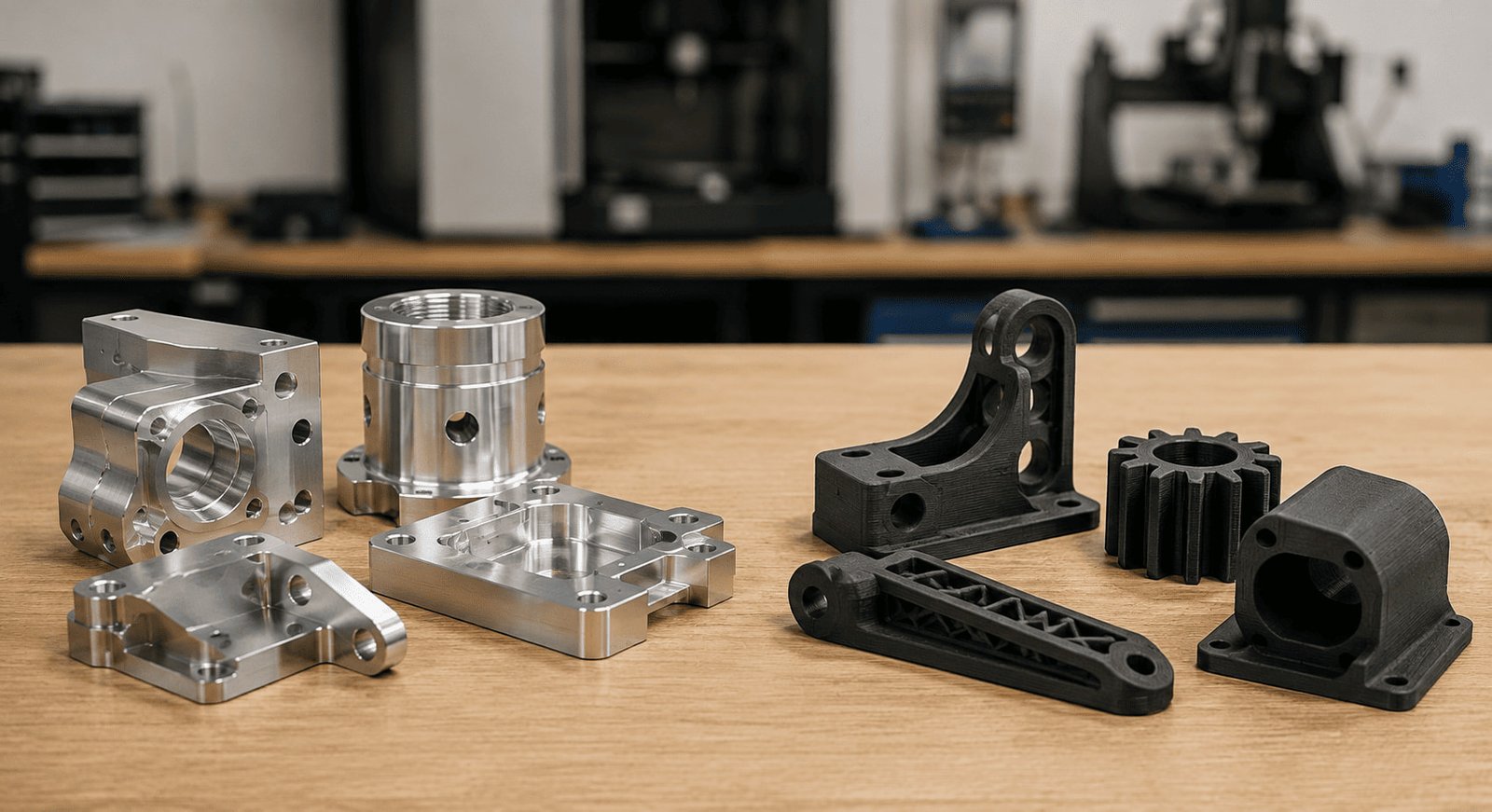
Choosing between subtractive CNC Machining and additive 3D printing comes down to material, tolerance, strength, surface finish, geometry, lead time, and budget. CNC removes material from solid stock to create precise, production-grade parts, while 3D printing builds parts layer by layer for fast iteration and complex shapes. The right process depends on what your part must do after it is made, how accurately it must fit, and whether it must perform under real operating conditions.
What is CNC Machining?
CNC Machining is a subtractive manufacturing process that uses computer-controlled tools to cut solid material into precise parts. It is widely used for metals and engineering plastics where strength, tight tolerances, smooth finishes, and repeatable production matter more than fast visual prototyping or highly organic geometry.
Core Manufacturing Concept
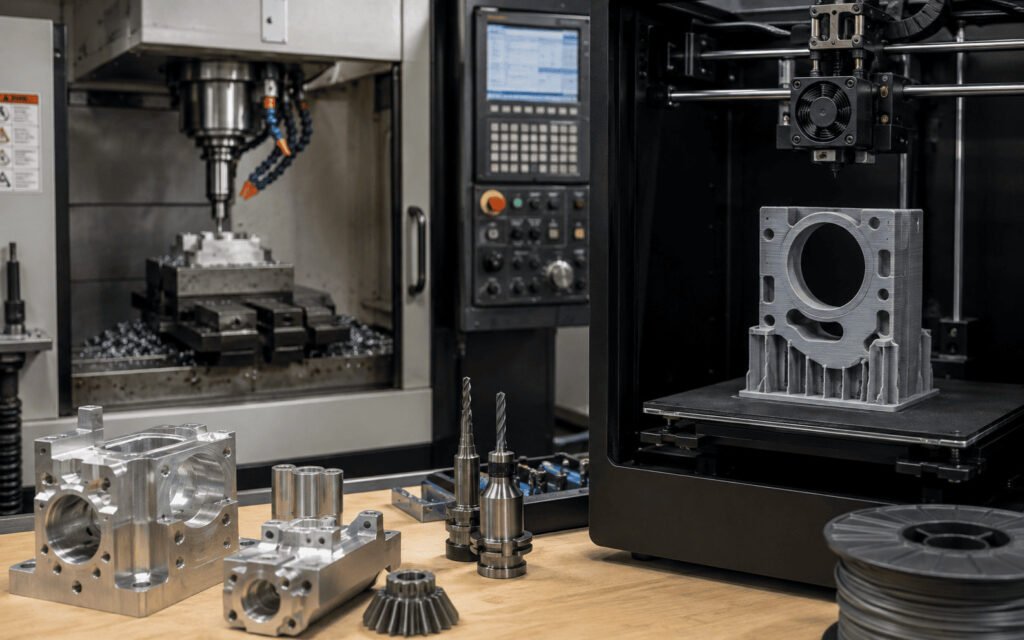
CNC stands for Computer Numerical Control. In practice, a digital design is converted into toolpaths that guide cutting tools across a workpiece. Instead of adding material layer by layer, CNC Machining removes unwanted material from billet, bar, plate, or casting stock until the final geometry is achieved.
Common CNC Machining Service outputs include precision enclosures, brackets, shafts, fixtures, housings, valve components, connectors, and functional prototypes. Depending on the geometry, a supplier may use milling, turning, Swiss machining, or combined turn-mill operations.
Based on our internal data and market analysis, here is the breakdown:
| CNC Process | Best For | Typical Parts |
|---|---|---|
| CNC Milling | Prismatic parts, pockets, slots, complex surfaces | cnc milling parts, housings, brackets |
| CNC Turning | Round or cylindrical components | cnc turning parts, shafts, bushings |
| CNC Lathe Work | High-volume rotational components | cnc lathe parts, pins, threaded parts |
| Swiss Machining | Small, slender, high-precision parts | swiss machined parts, medical and electronic components |
| Turn-Mill Machining | Parts needing both rotation and milled features | cnc turning milling parts, multi-feature connectors |
Luckyhxs Pro Tip: We usually recommend CNC Machining when the part must function under load, hold a precise fit, or represent the final production material closely.
How Does CNC Machining Work?
CNC Machining works by programming a machine tool to follow precise cutting paths generated from a CAD model. The machine clamps raw material, rotates or moves cutting tools, removes material in stages, and finishes the part to the required dimensions, tolerance, and surface quality.
From CAD Model to Finished Part
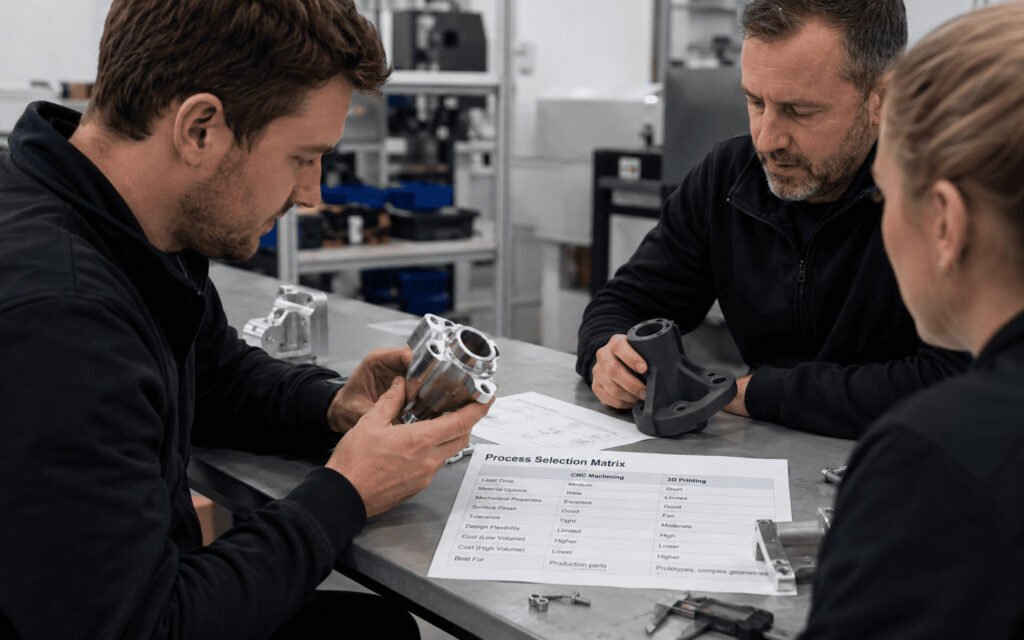
The workflow begins with a 3D CAD file or 2D drawing. Engineers then create CAM toolpaths that define cutting speed, feed rate, tool selection, depth of cut, and machining sequence. The program is transferred to the CNC machine, where the operator sets up material, fixtures, tools, and quality checks.
A typical CNC Machining workflow includes:
- Design review: Confirm geometry, tolerances, material, threads, and surface finish requirements.
- DFM assessment: Identify sharp internal corners, deep pockets, thin walls, and hard-to-machine features.
- CAM programming: Generate toolpaths for roughing, semi-finishing, finishing, drilling, tapping, or turning.
- Machine setup: Load raw stock, install tooling, set work offsets, and verify fixtures.
- Machining: Remove material through milling, turning, drilling, boring, tapping, or grinding.
- Inspection: Measure critical dimensions using calipers, micrometers, gauges, CMM, or optical systems.
- Post-processing: Apply deburring, polishing, anodizing, plating, heat treatment, or passivation if needed.
Luckyhxs Pro Tip: Before production, we always check whether a tolerance is truly functional. Over-tight tolerances can increase cost significantly without improving performance.
Is CNC harder than 3D printing?
CNC is generally harder to learn than desktop 3D printing because it requires deeper knowledge of materials, tooling, workholding, feeds, speeds, machine setup, and safety. However, CNC Machining delivers stronger, more accurate, and more production-ready parts when handled by experienced machinists or a qualified supplier.
Skill Requirements and Process Complexity
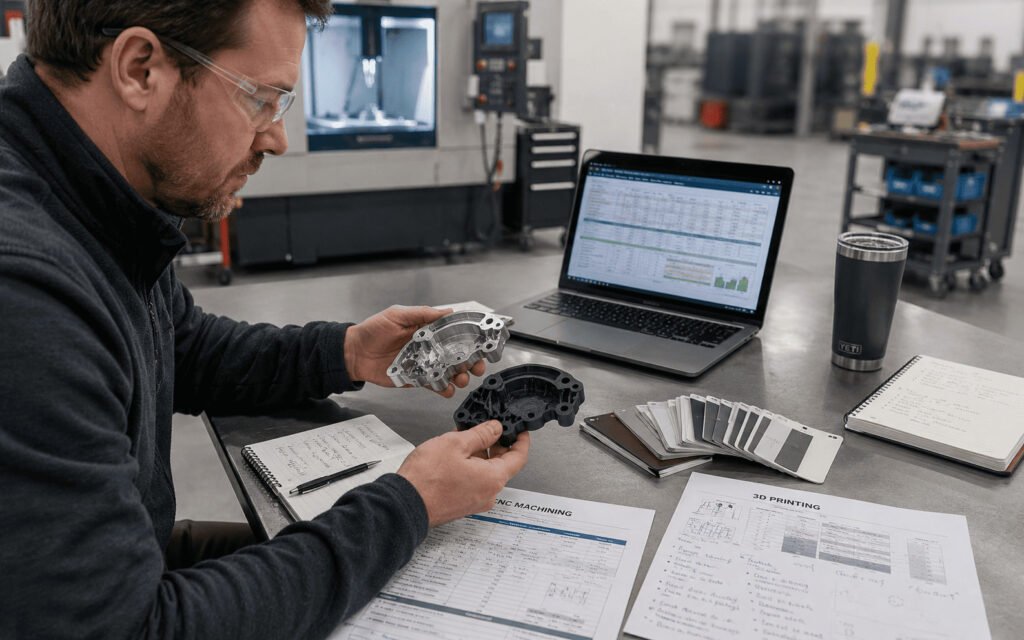
3D printing is often easier for early-stage prototypes because the machine can build complex shapes with minimal setup. CNC Machining requires more planning because the cutting tool must physically reach each feature, the workpiece must be held securely, and the machining strategy affects accuracy, surface finish, and final part cost.
Based on our internal data and market analysis, here is the breakdown:
| Factor | CNC Machining | 3D Printing |
|---|---|---|
| Setup Difficulty | Higher due to tooling and fixturing | Lower for simple prints |
| Operator Skill | Requires machining knowledge | Easier for entry-level users |
| Material Behavior | Must manage cutting forces and heat | Must manage warping and layer adhesion |
| Accuracy Control | Excellent with proper setup | Process-dependent |
| Safety Risk | Higher due to rotating tools and chips | Lower, but still requires ventilation and heat caution |
| Production Readiness | Strong for end-use parts | Strong for prototypes and selected end-use applications |
For a hobbyist, 3D printing is usually more accessible. For industrial production, CNC Machining is not “harder” in a negative sense—it is more controlled, more capable, and more dependent on expertise.
Luckyhxs Pro Tip: If your team lacks machining experience, outsourcing to a CNC Machining Service is often faster and safer than buying a machine and learning through costly trial and error.
Is machinist a dying trade?
No, machining is not a dying trade. The role is changing from manual operation toward digital manufacturing, automation, CAM programming, quality control, and process engineering. Skilled machinists remain essential because CNC machines still need human judgment for setup, tooling, troubleshooting, and precision production.
Why Machinists Still Matter
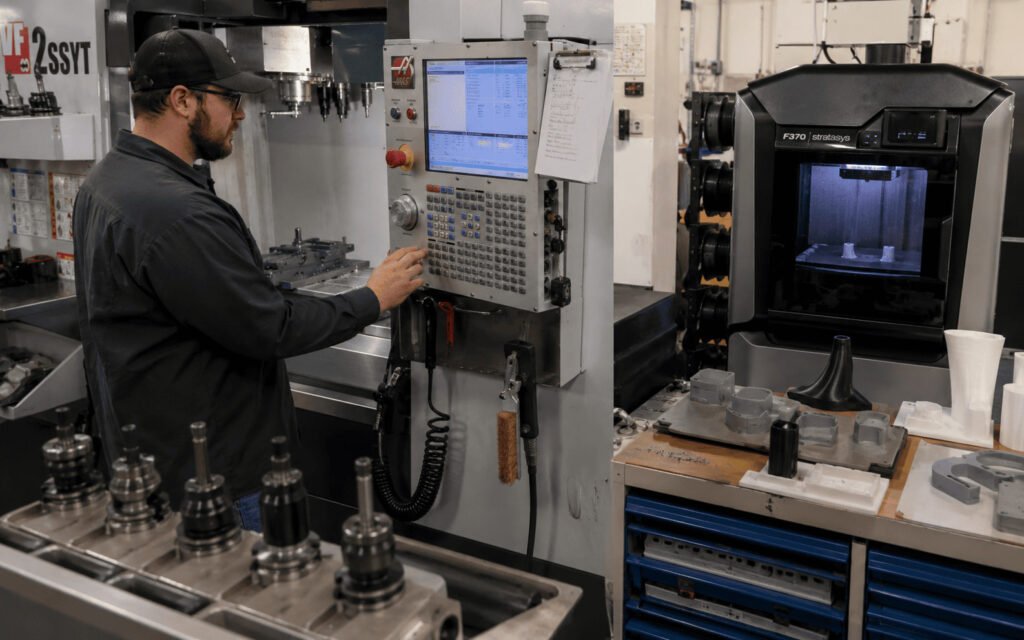
Modern CNC shops rely on automation, probing, multi-axis machining, robotic loading, and advanced software, but none of these eliminate the need for skilled people. A machinist understands how metal cuts, how parts distort, how tools wear, and how tolerances stack up in real assemblies.
Machining skills are evolving in several important directions:
- CAM programming: Creating efficient, safe, and accurate toolpaths.
- Multi-axis setup: Running 4-axis, 5-axis, Swiss, and turn-mill equipment.
- Inspection and metrology: Verifying precision parts against engineering drawings.
- Material expertise: Understanding aluminum, stainless steel, titanium, brass, copper, plastics, and exotic alloys.
- Process optimization: Reducing cycle time, improving finish, and increasing repeatability.
- Automation management: Supporting lights-out machining and robotic production cells.
In industries such as aerospace, medical devices, robotics, electronics, automotive, energy, and industrial equipment, the demand for precision cnc lathe parts, swiss machined parts, and cnc milling parts remains strong.
Luckyhxs Pro Tip: We see the best results when experienced machinists work closely with design engineers early, before a part is released for production.
Will 3D printing replace CNC?
3D printing will not fully replace CNC Machining because the two processes solve different manufacturing problems. 3D printing is excellent for fast iteration and complex internal geometry, while CNC remains the preferred choice for many strong, accurate, smooth, and material-certified end-use parts.
Complementary, Not Competitive
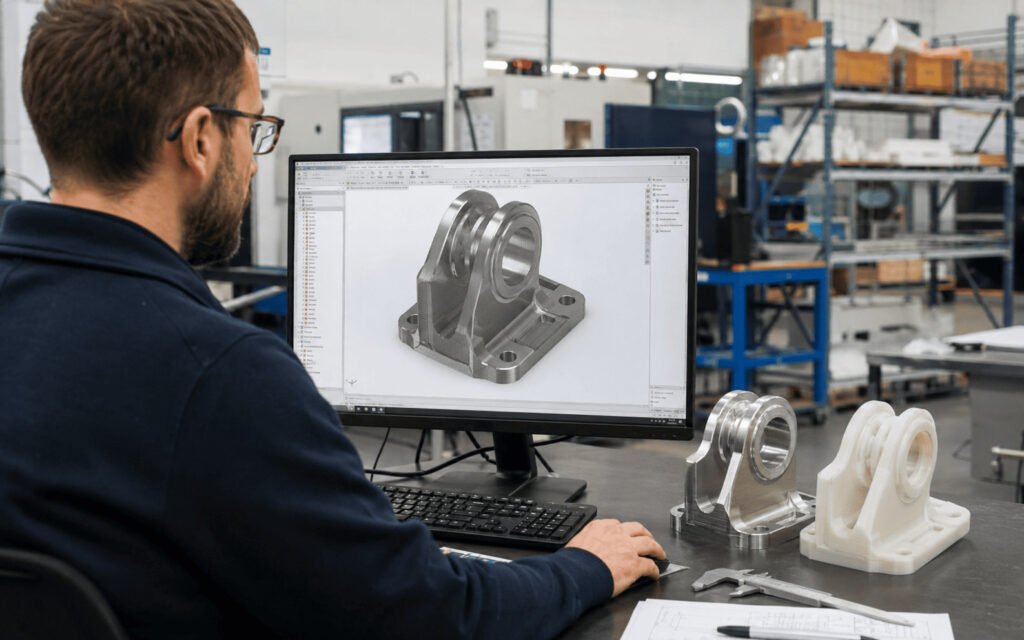
3D printing has become a powerful tool for prototypes, lightweight structures, lattice designs, custom fixtures, and some metal components. But CNC Machining continues to lead when parts require tight tolerances, consistent mechanical properties, superior surface finishes, and broad material availability.
Based on our internal data and market analysis, here is the breakdown:
| Requirement | Better Fit | Reason |
|---|---|---|
| Tight tolerance bores | CNC Machining | Better dimensional control |
| Smooth sealing surfaces | CNC Machining | Superior finish and flatness |
| Internal lattice structures | 3D Printing | Additive freedom |
| Certified billet material | CNC Machining | Predictable stock properties |
| Rapid visual prototype | 3D Printing | Faster and cheaper for early concepts |
| Production metal bracket | CNC Machining | Strength, finish, and repeatability |
| Lightweight organic geometry | 3D Printing | Less geometry restriction |
| Threaded metal part | CNC Machining | Strong, accurate threads |
Many companies use both: 3D printing for early design validation, then CNC Machining for functional prototypes, pilot runs, and production parts.
Luckyhxs Pro Tip: We often suggest printing the first shape study, then machining the engineering prototype once the design must be tested under real load, torque, temperature, or assembly conditions.
Key Features & Comparison
The best process depends on what matters most: geometry freedom, mechanical strength, precision, surface finish, material selection, cost, and quantity. CNC Machining generally wins for functional production parts, while 3D printing often wins for early prototypes, complex shapes, and low-strength concept models.
Process Selection Matrix
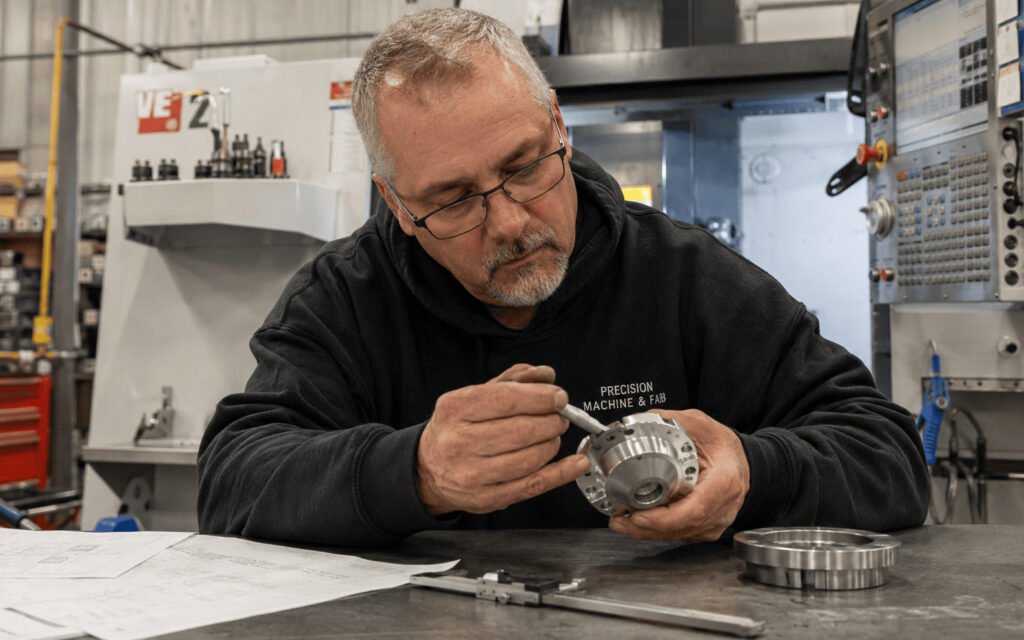
Based on our internal data and market analysis, here is the breakdown:
| Category | CNC Machining | 3D Printing |
|---|---|---|
| Manufacturing Method | Subtractive cutting from solid stock | Additive layer-by-layer build |
| Best Use Case | Functional prototypes and end-use parts | Concept models and complex geometries |
| Material Options | Aluminum, steel, stainless, brass, copper, titanium, plastics | Polymers, resins, composites, selected metals |
| Strength | Excellent, especially from billet stock | Varies by process, orientation, and material |
| Tolerance Capability | Very high with proper setup | Moderate to high depending on technology |
| Surface Finish | Smooth, precise, post-process friendly | Layer lines often require finishing |
| Geometry Freedom | Limited by tool access | Excellent for internal and organic shapes |
| Thin Walls | Possible but needs careful design | Possible but process-dependent |
| Threads and Fits | Excellent for precision mating features | Often needs inserts or post-machining |
| Setup Cost | Higher initial setup | Lower for single simple prototypes |
| Unit Cost at Volume | Often better for repeatable production | Can be higher for many identical parts |
| Lead Time | Fast with an experienced CNC Machining Service | Very fast for simple prototypes |
| Best Part Examples | cnc turning parts, cnc milling parts, cnc lathe parts | Mockups, jigs, form studies, complex lightweight parts |
When fit and function matter, CNC usually gives engineers more predictable results. When design exploration matters, 3D printing allows faster geometry changes with fewer manufacturing constraints.
Luckyhxs Pro Tip: For mating parts, we recommend CNC Machining for final holes, bearing seats, sealing faces, and threaded features, even if the early prototype was 3D printed.
Cost & Buying Factors
CNC Machining cost is driven by material, part complexity, tolerance, machine time, setup, quantity, and finishing. 3D printing can be cheaper for early prototypes, but CNC often becomes more cost-effective when strength, accuracy, finish, repeatability, and production-grade materials are required.
Pricing Drivers to Evaluate
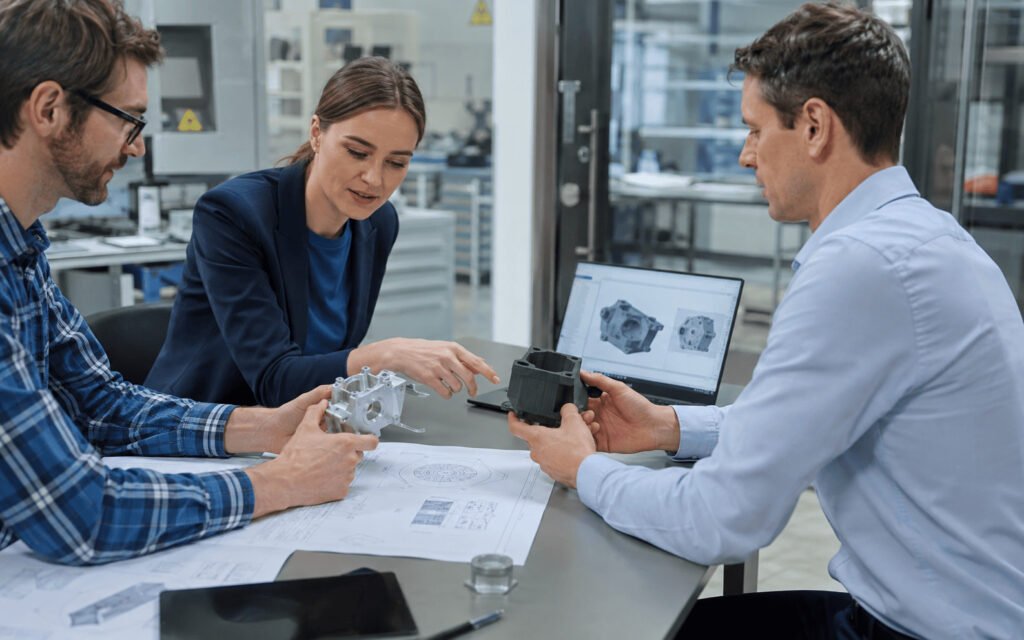
CNC pricing is not based only on part size. A small part with tight tolerances, deep pockets, thin walls, or multiple setups can cost more than a larger but simpler component. For buyers, the most important step is matching the process to the actual performance requirement instead of choosing only by initial quote.
Key buying factors include:
- Material selection: Aluminum is usually easier and cheaper to machine than stainless steel, titanium, or hardened alloys.
- Tolerance requirements: Tight tolerances require slower machining, better inspection, and more process control.
- Surface finish: Polishing, anodizing, plating, passivation, and bead blasting add cost but improve performance or appearance.
- Part geometry: Deep cavities, sharp internal corners, long threads, and thin walls increase machining difficulty.
- Order quantity: Setup cost is distributed across more parts, reducing unit cost at higher volume.
- Machine type: Swiss machined parts, 5-axis components, and turn-mill parts may require specialized equipment.
- Inspection level: Full dimensional reports, CMM inspection, and material certificates affect pricing.
- Supplier capability: A strong CNC Machining Service can reduce risk through DFM feedback and process planning.
For quote preparation, provide a 3D CAD file, 2D drawing, material grade, tolerance requirements, finish requirements, quantity, and application details. This helps Luckyhxs recommend the most practical production route.
Luckyhxs Pro Tip: If budget is tight, tell us which dimensions are critical and which are flexible. We can often reduce cost by relaxing non-functional tolerances or adjusting a feature for better machinability.
Conclusion
CNC Machining and 3D printing are both valuable, but they are not interchangeable. Use 3D printing for fast design exploration and complex prototypes; choose CNC Machining for strong, accurate, repeatable, production-ready parts that must perform reliably in real operating conditions.
Practical Decision Framework
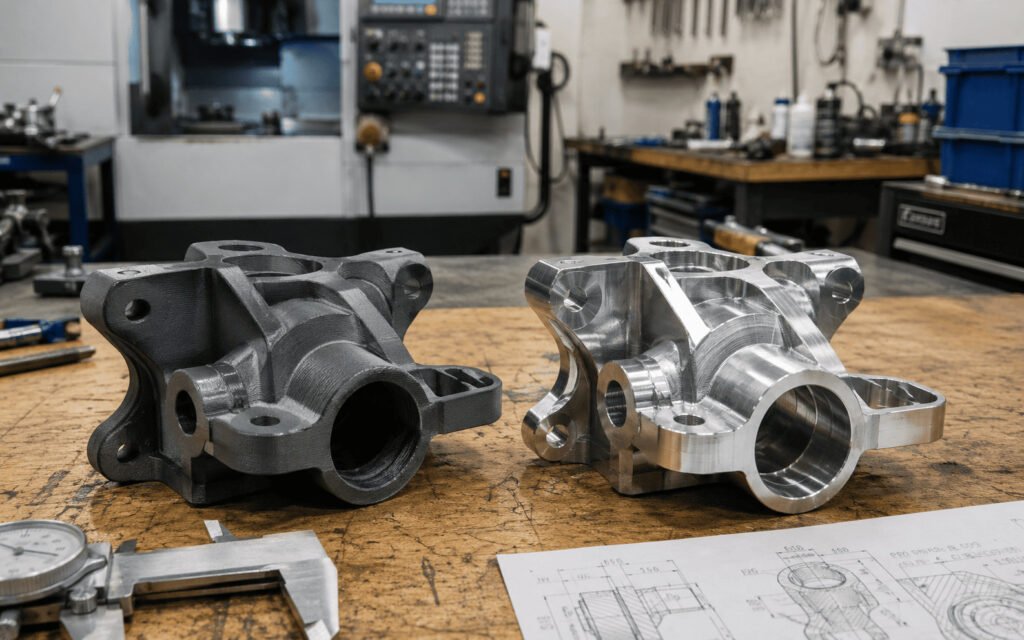
A good manufacturing decision starts with function. If the part only needs to communicate shape, 3D printing may be enough. If it must carry load, seal fluid, hold a bearing, align with another component, resist wear, or meet strict tolerances, CNC Machining is usually the safer path.
Use this quick checklist:
- Choose 3D printing when you need fast concept models, complex shapes, low-cost iteration, or lightweight non-critical prototypes.
- Choose CNC Machining when you need production materials, close tolerances, smooth surfaces, strong threads, precision fits, or consistent end-use performance.
- Use both when you want to validate the form quickly, then machine the final functional version.
- Contact Luckyhxs when you need cnc turning parts, cnc milling parts, cnc lathe parts, swiss machined parts, or complex cnc turning milling parts evaluated for manufacturability.
Luckyhxs Pro Tip: Send us your CAD file and application requirements before locking the process. We can help you decide whether CNC Machining, 3D printing, or a combined approach will deliver the best result for your part.