
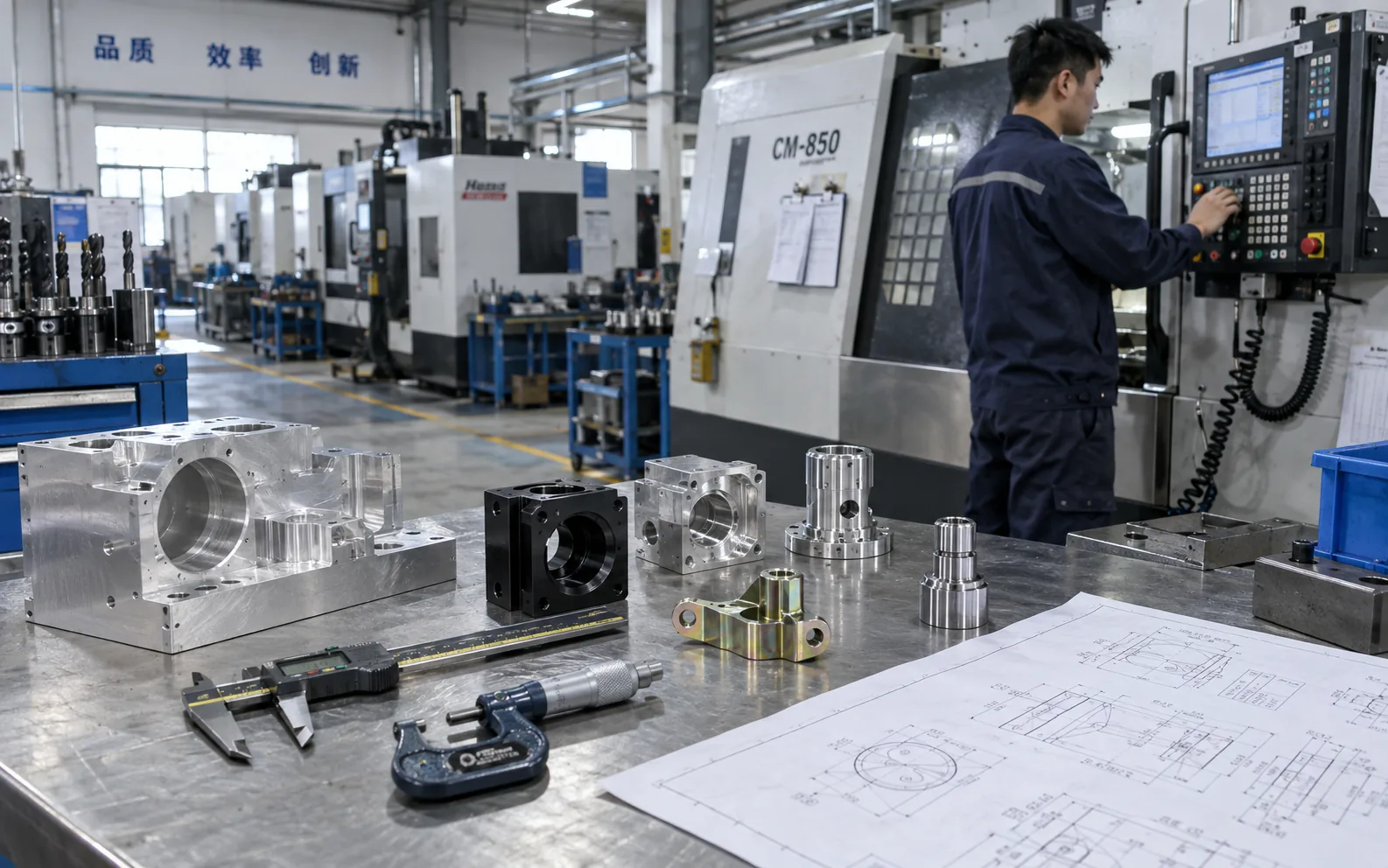
In most CNC manufacturing cases, drawing dimensions apply to the finished part after machining, plating, anodizing, coating, or other surface finishing unless the drawing clearly states otherwise. This distinction matters because even thin finishes can change critical sizes, fits, threads, bores, and tolerances. For custom CNC machined parts, Luckyhxs recommends confirming finishing assumptions before production begins.
How CNC Surface Finishing Affects Final Part Dimensions
CNC surface finishing is the post-machining treatment applied to custom CNC machined parts to improve appearance, corrosion resistance, wear resistance, or function. Unless otherwise specified, drawing dimensions normally refer to finished part dimensions, meaning the final measured size after anodizing, plating, passivation, coating, or other finishing processes.
Finished Dimensions and Surface Treatments
CNC surface finishing includes processes applied after precision CNC milling parts and precision CNC turned parts are machined. These finishes can be cosmetic, protective, functional, or all three. The key engineering issue is that many finishes add material, remove material, or alter the surface layer, which affects dimensional inspection.
Based on our internal data and market analysis, here is the breakdown:
| Finish Type | Common Material | Dimensional Effect | Typical Concern |
|---|---|---|---|
| Anodizing | Aluminum | Partial surface growth and penetration | Bores, threads, close-fit pockets |
| Hard anodizing | Aluminum | Greater buildup than standard anodizing | Sliding fits, bearing seats |
| Electroless nickel plating | Aluminum, steel, brass | Uniform coating buildup | Precision shafts, sealing faces |
| Zinc plating | Steel | Adds coating thickness | Thread engagement, hole clearance |
| Passivation | Stainless steel | Minimal dimensional change | Cleanliness, corrosion resistance |
| Bead blasting | Aluminum, stainless steel | Slight texture change | Cosmetic consistency |
| Powder coating | Aluminum, steel | Significant coating thickness | Masking, mating surfaces |
For anodized aluminum CNC parts, the coating does not simply sit on top of the surface. A portion grows outward while another portion penetrates into the base material. This means critical dimensions may need machining compensation before finishing.
Luckyhxs Pro Tip: I always recommend marking critical features on the drawing and stating “dimensions apply after finish” or “machine dimensions before finish” where needed. This prevents confusion between design intent, machining allowance, and final inspection criteria.
How to Control CNC Dimensions Before and After Finishing
The process works by machining the part to a controlled pre-finish size, applying the specified surface treatment, then inspecting the final dimensions against the drawing. For close-tolerance custom CNC machined parts, the manufacturer must compensate for coating buildup, material removal, or surface conversion before finishing begins.
Dimensional Control Through Machining and Finishing
For precision CNC milling parts and precision CNC turned parts, dimensional control is not only about the CNC machine accuracy. It also depends on how the finish changes the surface. A reliable workflow connects engineering, machining, finishing, and inspection.
Typical process flow:
- Review the drawing notes, tolerances, material, and finish requirements.
- Identify critical dimensions such as bores, shafts, grooves, sealing faces, threads, and mating surfaces.
- Determine whether the finish adds thickness, removes material, or creates conversion growth.
- Adjust pre-finish machining dimensions when required.
- Mask features that should not receive coating or plating.
- Apply anodizing, plating, passivation, coating, polishing, or blasting.
- Inspect finished part dimensions according to the drawing and quality standard.
If the drawing does not specify otherwise, most buyers and inspectors expect dimensions after plating or anodizing to be the acceptance condition. However, suppliers should not assume when tight tolerances are involved. A small coating thickness can be enough to make a bore undersized or a shaft oversized.
Luckyhxs Pro Tip: When we see tolerances tighter than the expected coating variation, we clarify the inspection condition before quoting. This avoids producing a technically well-made part that fails final inspection because the finish was not considered.
Why Post-Finish Dimensional Control Matters for CNC Parts
The main benefits are improved durability, corrosion protection, wear performance, electrical behavior, appearance, and final product reliability. When CNC dimensions after finishing are properly controlled, customers receive parts that not only look correct but also assemble correctly and perform as intended in real applications.
Functional and Commercial Advantages
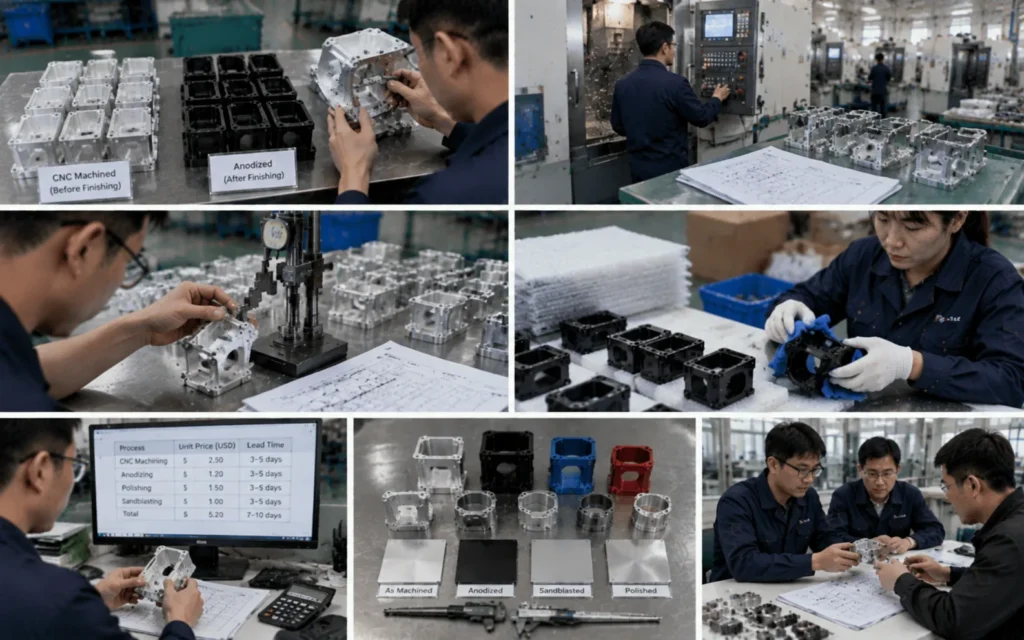
Surface finishing turns machined components into production-ready parts. It can make aluminum more corrosion resistant, steel more durable, stainless steel cleaner, and visible parts more attractive. For OEMs, the biggest value is consistency: finished part dimensions match the design requirements.
Key benefits include:
- Better corrosion resistance for outdoor, marine, medical, and industrial environments.
- Improved wear resistance on sliding, rotating, or contact surfaces.
- Enhanced cosmetic appearance through anodizing, polishing, brushing, or blasting.
- Better part identification using color anodizing, laser marking, or black oxide.
- Improved electrical insulation or conductivity depending on the finish.
- Higher customer confidence because final dimensions match the drawing after finishing.
- Reduced assembly problems caused by uncontrolled plating or coating buildup.
For anodized aluminum CNC parts, finishing is often both cosmetic and functional. A black anodized enclosure, for example, must look consistent while still meeting hole, thread, and mating-face requirements.
Luckyhxs Pro Tip: I treat finishing as part of the dimensional design, not as decoration added at the end. If a part has press fits, threaded holes, sealing faces, or bearing surfaces, finishing strategy should be decided before machining starts.
How to Protect Finished CNC Parts and Maintain Dimensional Accuracy
Maintaining finished CNC parts means protecting the surface treatment and preserving the final dimensions during handling, cleaning, assembly, storage, and use. Avoid abrasive cleaning, uncontrolled chemical exposure, impact damage, and improper torque because these can damage coatings, change fit conditions, or reduce corrosion resistance.
Care Guidelines for Finished CNC Parts
Different finishes require different maintenance methods. Anodized aluminum CNC parts are durable but can be damaged by strong alkaline cleaners. Plated parts may corrode if scratched through to the base material. Powder-coated surfaces can chip under impact. Precision surfaces require extra care.
Recommended maintenance practices:
- Use neutral cleaners instead of strong acids or alkalis unless approved.
- Avoid steel tools or abrasive pads on cosmetic anodized surfaces.
- Protect threads and bores from contamination during storage.
- Use soft packaging to prevent finished surfaces from rubbing during transport.
- Apply correct assembly torque to avoid cracking coatings or deforming parts.
- Keep plated steel parts dry if the application requires corrosion control.
- Inspect critical finished part dimensions after any rework or refinishing.
For custom CNC machined parts, maintenance is also about traceability. If a finished part is reworked, stripped, re-plated, or re-anodized, its dimensions may change again. Re-inspection is necessary when tight tolerances are involved.
Luckyhxs Pro Tip: I recommend keeping finished parts separated by material, finish, and revision level. Mixing unfinished, pre-finish, and finished parts in the same area is one of the easiest ways to create inspection and assembly mistakes.
CNC Surface Finishing Cost & Pricing Factors
The price depends on material, part geometry, tolerance requirements, finish type, masking needs, batch quantity, inspection level, and cosmetic standard. Simple anodizing or passivation is usually cost-effective, while hard anodizing, electroless nickel plating, precision masking, and tight post-finish inspection increase total manufacturing cost.
Pricing Variables That Affect Finished CNC Parts
Finishing cost is not only the price of the coating process. It includes preparation, cleaning, racking, masking, handling, inspection, packaging, and possible machining compensation. Tight tolerance parts cost more because the supplier must control both machining and final finishing variation.
Based on our internal data and market analysis, here is the breakdown:
| Cost Factor | Low-Cost Scenario | Higher-Cost Scenario |
|---|---|---|
| Finish type | Clear anodizing, passivation | Hard anodizing, electroless nickel, multilayer coating |
| Geometry | Simple flat or turned parts | Deep holes, blind pockets, complex internal features |
| Tolerance | General tolerances | Tight CNC dimensions after finishing |
| Masking | No masking required | Threads, bores, sealing faces, electrical contact areas |
| Appearance | Industrial finish | High cosmetic standard, color matching |
| Quantity | Batch production | Prototype or small-quantity setup |
| Inspection | Basic dimensional check | Full post-finish inspection report |
For accurate pricing, Luckyhxs typically needs a 2D drawing, 3D CAD file, material specification, finish requirement, tolerance standard, quantity, and any cosmetic or inspection expectations.
Luckyhxs Pro Tip: If you want the most accurate quote, send both the CAD file and a drawing with clear finish notes. A model alone rarely tells us whether dimensions are before finish, after finish, or controlled only in selected areas.
Key Features & Comparison
The key feature of professionally finished CNC parts is controlled performance after all manufacturing steps are complete. Comparing unfinished, pre-finish, and finished dimensions helps engineers choose the right drawing notes, inspection method, and supplier process for anodized aluminum, plated, milled, and turned components.
Comparison of Dimension Conditions
Based on our internal data and market analysis, here is the breakdown:
| Dimension Condition | Meaning | When It Is Used | Risk If Not Defined |
|---|---|---|---|
| Before finish | Measurement taken after machining but before coating or plating | Supplier process control, coating allowance planning | Final part may not meet assembly fit |
| After finish | Measurement taken after all surface treatments | Standard final inspection and customer acceptance | Requires accurate finish compensation |
| Masked feature | Finish is prevented from covering selected areas | Threads, bores, electrical contacts, sealing faces | Poor masking can cause fit or conductivity issues |
| Cosmetic-only surface | Appearance controlled more than dimension | Covers, housings, visible brackets | Color or texture mismatch |
| Functional coating surface | Finish affects wear, corrosion, insulation, or friction | Moving parts, shafts, fixtures, enclosures | Performance failure if thickness varies |
| Critical-to-quality feature | Dimension must be tightly controlled after finishing | Bearing fits, dowel holes, precision slots | Rework, scrap, or assembly rejection |
Finished part dimensions should be clearly identified when the finish can affect assembly or performance. A general note may be enough for simple parts, but critical features often need specific callouts such as “ID Ø20.00 ±0.02 after anodize” or “mask thread before plating.”
Luckyhxs Pro Tip: I prefer feature-level notes for critical areas instead of relying only on a general drawing note. It gives machinists, finishers, and inspectors the same target and reduces interpretation errors.
Cost & Buying Factors
When buying finished CNC parts, evaluate more than unit price. The best supplier should understand machining allowance, coating thickness, masking, inspection after finishing, packaging protection, and revision control. Low-cost quotes can become expensive if finished dimensions are not controlled from the beginning.
Supplier Selection Checklist
Choosing a supplier for custom CNC machined parts with finishing requirements requires both machining capability and finishing knowledge. The supplier must understand how the final surface treatment interacts with engineering tolerances, function, and appearance.
Important buying factors:
- Confirm whether the quote includes machining, finishing, inspection, and packaging.
- Ask how the supplier handles drawing dimensions after plating or anodizing.
- Check whether critical features can be masked before finishing.
- Confirm expected coating thickness and dimensional impact.
- Request inspection after finishing for tight-tolerance features.
- Review cosmetic standards for visible parts.
- Make sure revision changes are controlled before repeat orders.
- Verify whether the supplier has experience with both precision CNC milling parts and precision CNC turned parts.
A slightly higher quote may provide better value if it includes finish-aware machining, reliable quality control, and fewer assembly problems. For production parts, stable repeatability is often more important than the lowest prototype price.
Luckyhxs Pro Tip: I recommend asking suppliers one direct question: “Will these dimensions be inspected before or after finishing?” Their answer quickly shows whether they understand finished part dimension control.
Conclusion
Drawing dimensions usually apply to the finished part after all finishing processes unless the drawing states a different requirement. For reliable CNC production, engineers and buyers should clearly define coating thickness, masking, inspection condition, and critical finished dimensions before ordering custom CNC machined parts.
Final Engineering Guidance
The safest approach is to remove ambiguity from the drawing. CNC surface finishing can improve performance and appearance, but it can also affect dimensions enough to create assembly failures. This is especially important for anodized aluminum CNC parts, plated components, tight bores, precision shafts, threads, and mating surfaces.
Use these drawing practices:
- State whether dimensions apply before or after finishing.
- Add specific notes for critical post-finish features.
- Define finish type, color, thickness, and standard when applicable.
- Identify masked areas clearly.
- Require final inspection after finishing for critical dimensions.
- Share functional requirements with the manufacturer when tolerances are tight.
Luckyhxs supports custom CNC machined parts from machining through finishing and inspection, helping customers control both the technical function and the final appearance of precision components.
Luckyhxs Pro Tip: If you are unsure how finishing will affect your part, send the drawing before production. We can review the tolerance stack, recommend finish notes, and help make sure the delivered part matches the finished design intent.