
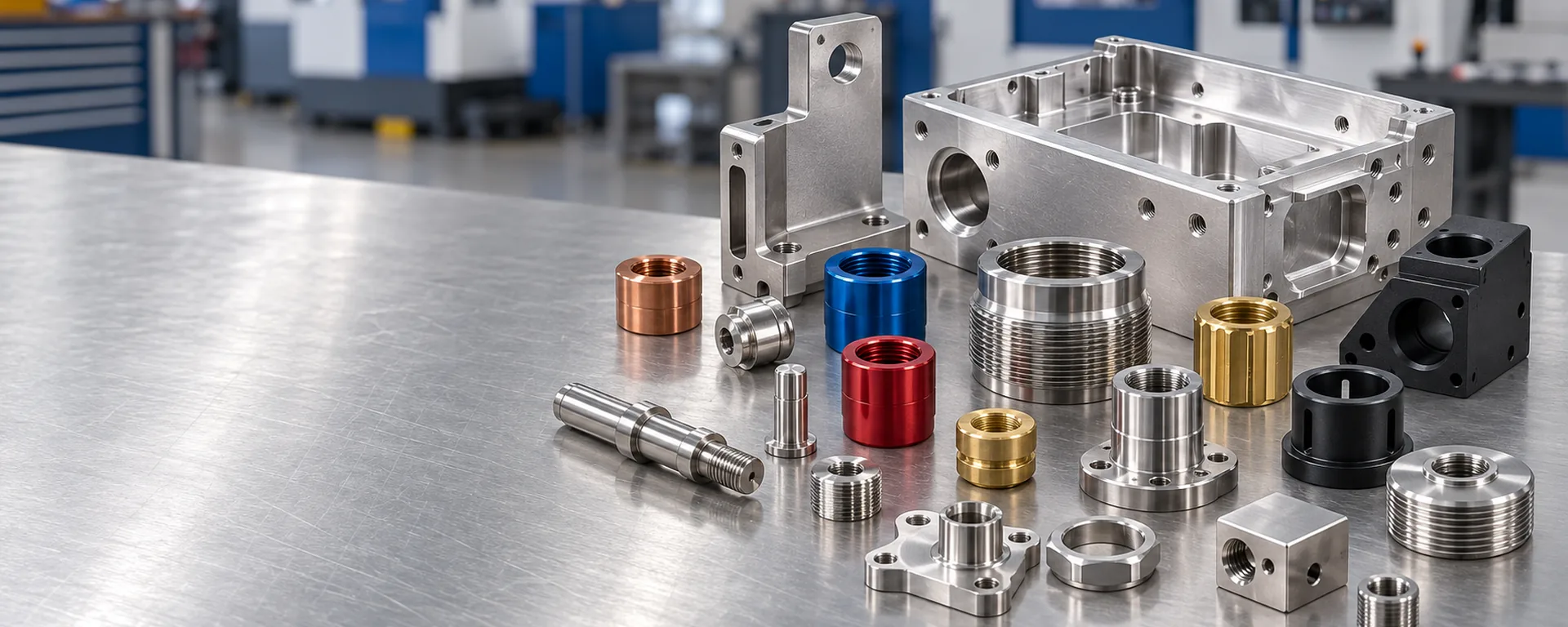
Stainless steel CNC machining services turn a specified stainless alloy into made-to-drawing components through CNC turning, milling, Swiss-type machining, turn-mill machining, and related secondary operations. A reliable RFQ therefore needs more than a part name: the grade, drawing revision, functional datums, critical features, quantity, surface requirements, inspection needs, and service environment can all change the manufacturing route.
LuckyHXS manufactures custom components from customer drawings or approved samples rather than selling raw stainless stock or standard retail hardware. This FAQ answers the questions engineers and sourcing teams commonly need to resolve before sampling or repeat production. For an overview of suitable part families, visit stainless steel CNC machining services.
1. What Are Stainless Steel CNC Machining Services?
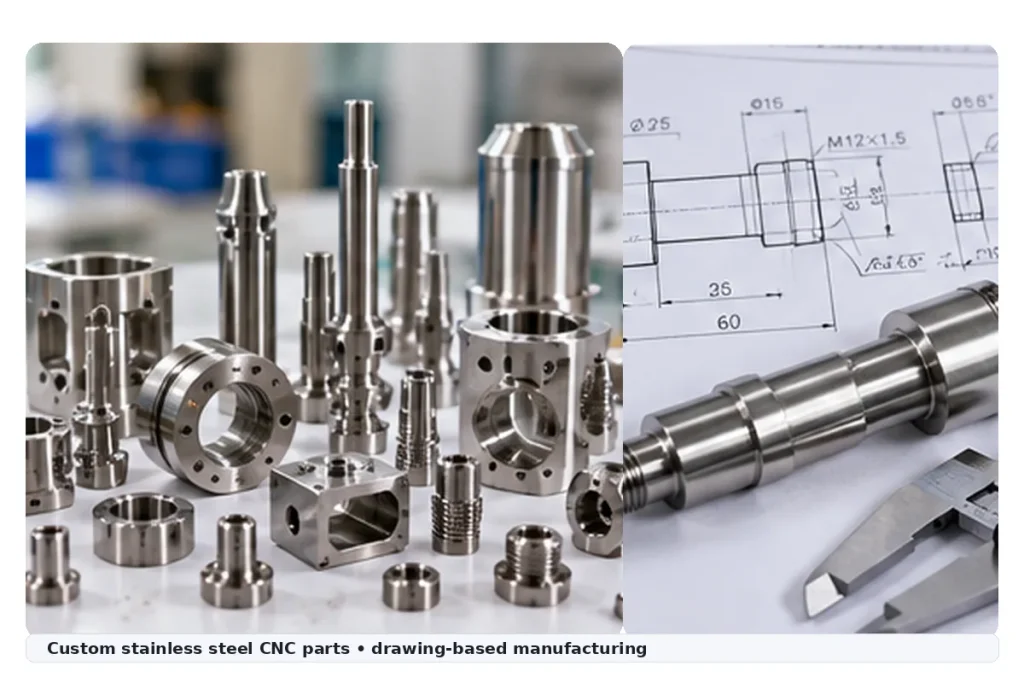
Stainless steel CNC machining services manufacture finished custom parts by removing material from stainless bar, plate, or other specified stock under computer control. Depending on the geometry, the route may include turning, milling, Swiss-type machining, turn-mill machining, drilling, boring, threading, deburring, cleaning, finishing, and inspection.
The correct route follows the part’s function and geometry. Rotational components such as shafts, pins, sleeves, bushings, and fittings often begin with turning. Housings, brackets, manifolds, pockets, and multi-face hole patterns usually require milling. Slender bar parts may suit Swiss-type machining, while a round part with flats, slots, radial holes, or off-axis features may benefit from turn-mill production.
The service scope should also define what makes the part acceptable in assembly. Fit, motion, sealing, alignment, thread engagement, cleanliness, surface condition, and appearance can be more important than the general component name.
2. Which Stainless Steel Grades Can LuckyHXS Review?
LuckyHXS company materials support evaluation of 303, 304, and 316F stainless steel machining projects. Exact availability, condition, source, quantity, and documentation still need confirmation for each RFQ. If a drawing specifies 316, 316L, 416, 17-4 PH, duplex stainless, or another alloy, include the full material designation and applicable standard so sourcing and manufacturability can be reviewed before quotation.
Avoid a material callout that says only “stainless steel.” Grades differ in machinability, corrosion behavior, strength, heat-treatment condition, weldability, chip formation, cutting heat, tool wear, and burr tendency. They are not automatically interchangeable.
If the project requires material certificates, traceability, regulatory documentation, or an approved mill source, state that requirement in the RFQ. A grade name alone does not imply a particular document package or compliance status.
3. How Should Buyers Choose Between 303, 304, 316, and 316L?
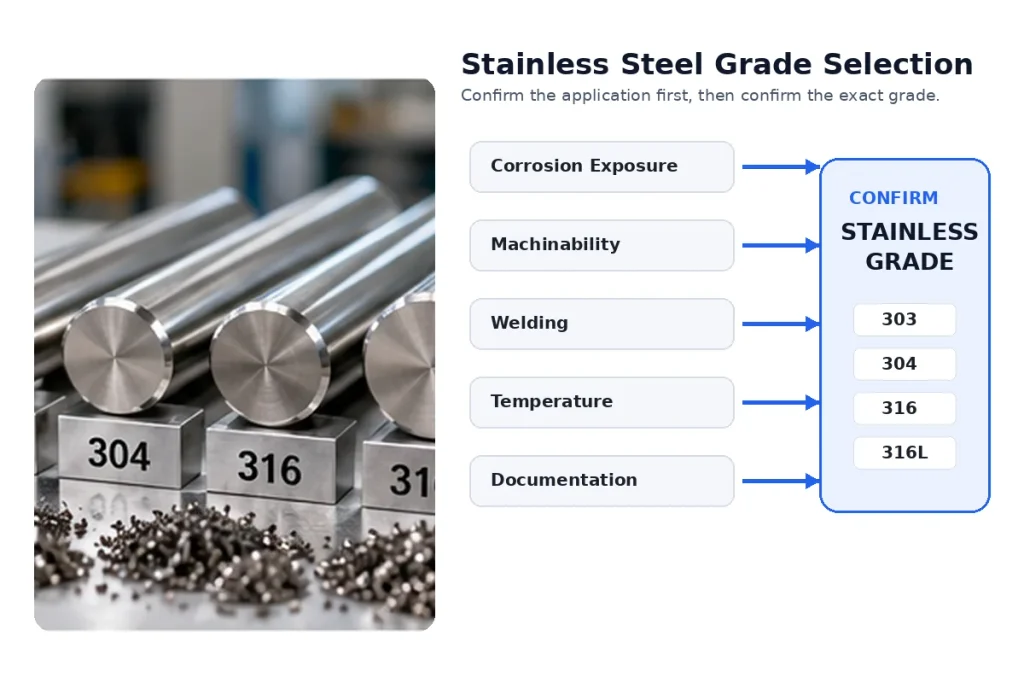
Buyers should select the stainless grade from the operating environment and functional requirements first, then consider machinability and finished-part cost.
- 303 is commonly considered when machinability and chip control are priorities and the corrosion environment permits its use.
- 304 is a widely used general-purpose grade, but it can work-harden and form long chips during machining.
- 316 and 316L are often considered where chloride or chemical exposure makes stronger corrosion resistance important. The exact grade, condition, and documentation must match the application.
- 316F is a free-machining variant that may suit selected turned parts, but it should not be substituted for 316 or 316L without design approval.
Selection may also depend on welding, temperature, cleaning chemicals, mating materials, finish, documentation, and application-specific standards. For a focused comparison, see 303 vs 304 vs 316 stainless steel for CNC machining.
4. Why Is Stainless Steel Harder to Machine Than Aluminum or Brass?
Many stainless grades are harder to machine because they can work-harden, retain heat near the cutting edge, form long chips, and accelerate tool wear. Those behaviors can cause dimensional drift, rough bores, damaged threads, built-up edges, burrs, and inconsistent surfaces if the process is not planned for the exact alloy and geometry.
There is no universal speed-and-feed recipe. Tool condition, rigid workholding, positive cutting action, coolant delivery, chip evacuation, wall thickness, feature depth, and production quantity all affect the result. The thyssenkrupp stainless-steel technical brochure provides additional background on machining behavior and process control for stainless alloys.
Buyers do not need to prescribe proprietary tooling parameters. Instead, identify the features that cannot drift—such as a bearing diameter, sealing bore, thread, runout relationship, or cosmetic face—so the machining and inspection plan can protect them.
5. Which CNC Process Fits a Stainless Steel Part?
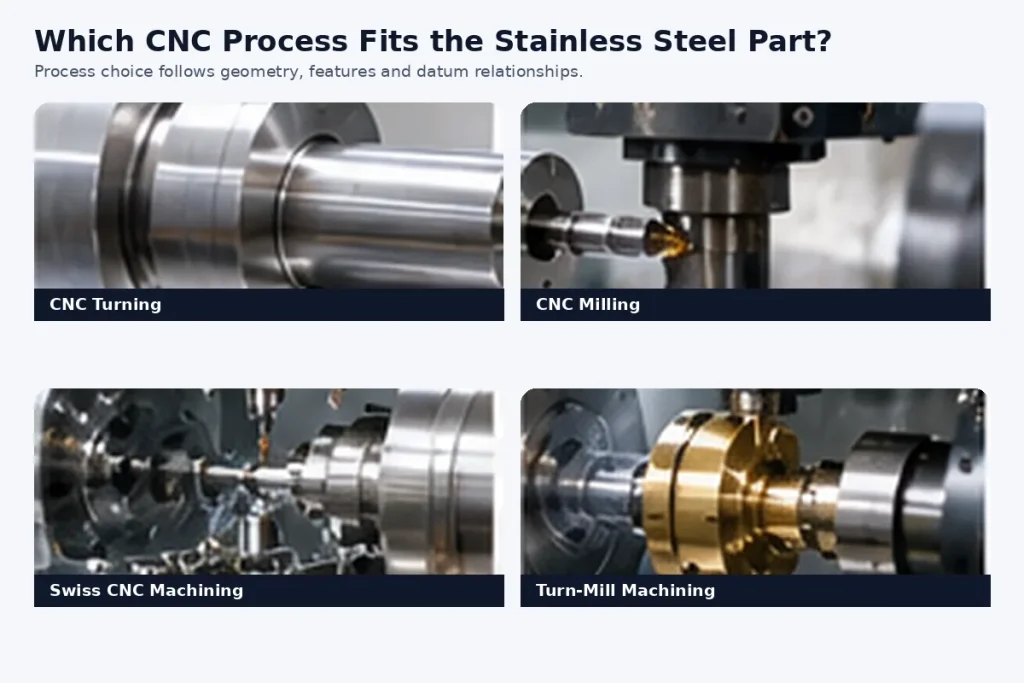
The most suitable CNC process depends on geometry, critical feature relationships, quantity, finishing, and inspection—not on the material keyword alone.
- CNC turning suits many shafts, pins, sleeves, bushings, fittings, and threaded bodies organized around a primary axis.
- CNC milling suits housings, brackets, manifolds, flanges, pockets, and multi-face hole patterns.
- Swiss CNC machining may suit small-diameter or slender bar parts that benefit from support close to the cutting zone.
- CNC turning and milling may reduce handling when a round part also needs flats, slots, radial ports, cross holes, or off-axis features.
A process name does not guarantee the result. Ask how the proposed setup preserves the functional datums, how many times the part must be re-clamped, when secondary operations occur, and how critical relationships will be checked after all relevant operations.
6. Can Stainless Steel CNC Parts Hold Tight Tolerances?
Yes, suitable stainless steel features can hold tight tolerances, but capability must be reviewed feature by feature against the actual drawing. Alloy, stock condition, part size, wall thickness, tool reach, datum scheme, setup count, finishing route, batch quantity, and inspection method all influence what is practical.
A short, rigid pin diameter is not equivalent to a deep bore in a thin sleeve. A drawing can also show acceptable individual sizes while the assembly fails because runout, position, perpendicularity, or face-to-axis relationships were not controlled. Feature-specific tolerances should therefore protect function rather than make every dimension unnecessarily restrictive.
Mark the critical dimensions and explain whether they control fit, motion, sealing, alignment, or interchangeability. Where the measurement method could change the result, agree on it before production. LuckyHXS can review the drawing and inspection approach through its CNC machining quality inspection workflow. Do not rely on a blanket tolerance claim from a general capability page.
7. What Should a DFM Review Cover Before Quotation?
A useful DFM review should identify the features that create machining, inspection, finishing, or repeat-production risk before the price and process are fixed.
The review should cover:
- The functional datum structure and relationships between bores, outside diameters, shoulders, faces, holes, and threads.
- Deep holes, small tools, long reach, chip evacuation, and restricted deburring access.
- Thin walls, interrupted cuts, clamping surfaces, free-state geometry, and distortion after release.
- Internal corner radii, thread relief, tool access, and whether a feature requires another setup.
- Which tolerances and surface requirements are truly functional and how they will be inspected.
- Finish allowance, masking, post-finish dimensions, cleaning, packaging, and required documents.
DFM feedback should not silently change the design. It should make trade-offs visible so the buyer can approve a radius, tolerance, datum, material, or process change when appropriate. Supplying both a 2D drawing and a usable 3D model usually reduces ambiguity, while the drawing remains the authority for tolerances, notes, and acceptance criteria.
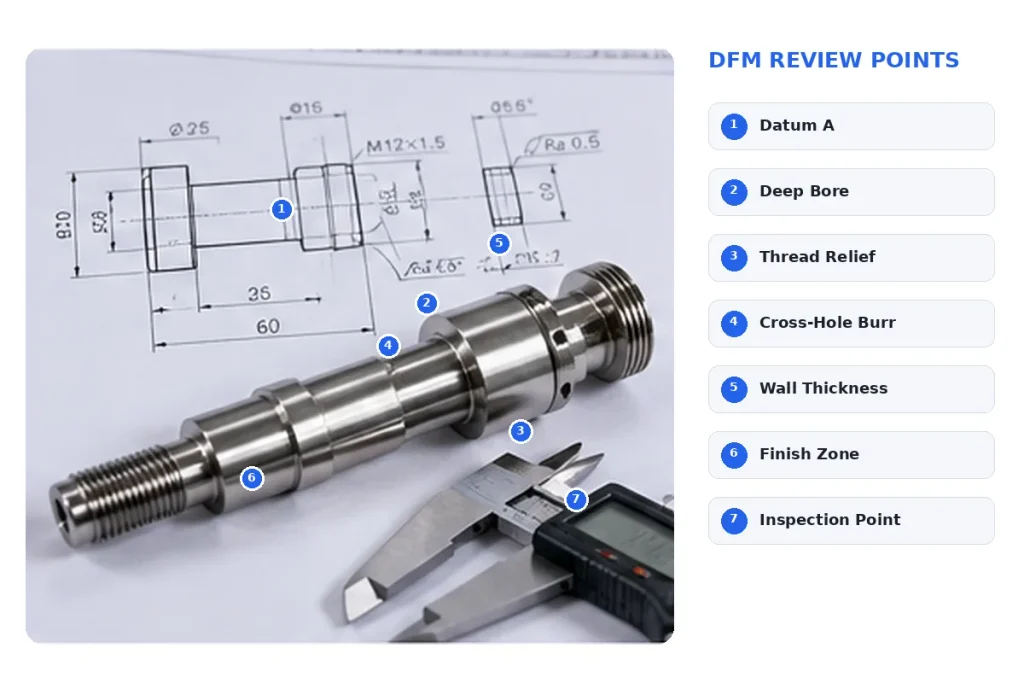
8. How Are Threads, Small Holes, Thin Walls, and Burrs Controlled?
These features are controlled by defining their function clearly and planning machining, deburring, cleaning, and inspection around the access and distortion risks.
For a blind or small hole, specify diameter, depth, bottom condition, surface requirement, and whether trapped chips could obstruct assembly or flow. For cross holes and intersecting passages, identify internal edges that must be free of obstructive burrs. For threads, specify the standard, size, class or fit, engagement length, entry chamfer, runout or relief, and any required functional gauging.
Thin sleeves, connector shells, small flanges, and milled housings can distort under chuck or fixture pressure and spring after release. Mark the functional bore, wall thickness, datum references, roundness or flatness requirements, and the free-state condition in which the part should be inspected.
The drawing should distinguish an edge that must be broken from one that must remain sharp. LuckyHXS can review accessible edge requirements through its deburring services process, but the feasible method and acceptance criteria depend on part geometry. Inspection should also match the feature; a caliper is not a substitute for a thread gauge, bore method, optical check, or other project-appropriate measurement.
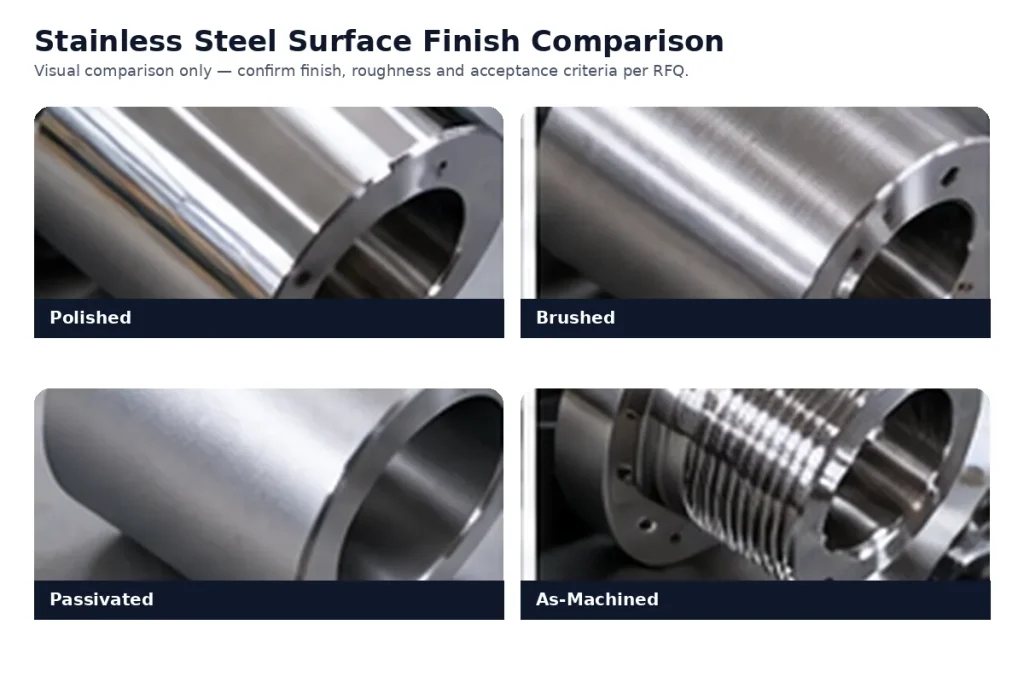
9. Do Stainless Steel CNC Parts Need Passivation, Polishing, or Brushing?
Not automatically; finishing should follow the environment, appearance, cleanliness, roughness, mating function, and applicable specification. An as-machined surface may be acceptable for an internal industrial component, while another part may require a defined polished or brushed zone. Passivation should be specified and confirmed only when it is part of the project’s technical requirements.
Finishing can affect cost, edge condition, appearance, inspection sequence, and sometimes critical dimensions. State the exact surface zones, required roughness or visual standard, brushing direction, masking, pre- or post-finish dimensions, and acceptance method. Availability and the processing route—including whether an approved outside source is involved—must be confirmed for the RFQ.
For related planning guidance, compare mechanical polishing vs brushing for stainless steel parts and review LuckyHXS surface finishing services.
10. Can Machined Stainless Steel Parts Still Develop Rust Spots?
Yes, because stainless steel is corrosion-resistant rather than universally corrosion-proof. Alloy selection, chloride or chemical exposure, temperature, surface roughness, embedded free iron, cleaning residue, handling, storage, and finishing can all influence surface performance.
A rust-colored spot does not by itself prove that the bulk alloy is wrong. Surface contamination introduced during machining, grinding, transport, assembly, or maintenance can also be involved. Investigation should separate material identity from surface condition and actual service exposure.
To reduce uncertainty, specify the exact grade and standard, environmental exposure, cleaning restrictions, cosmetic criteria, and any required treatment or corrosion test. If corrosion performance is safety-critical or regulated, the responsible design authority should define the material, treatment, validation method, and acceptance standard instead of relying on a generic “stainless” note.
11. Can LuckyHXS Support Prototypes and Repeat Production?
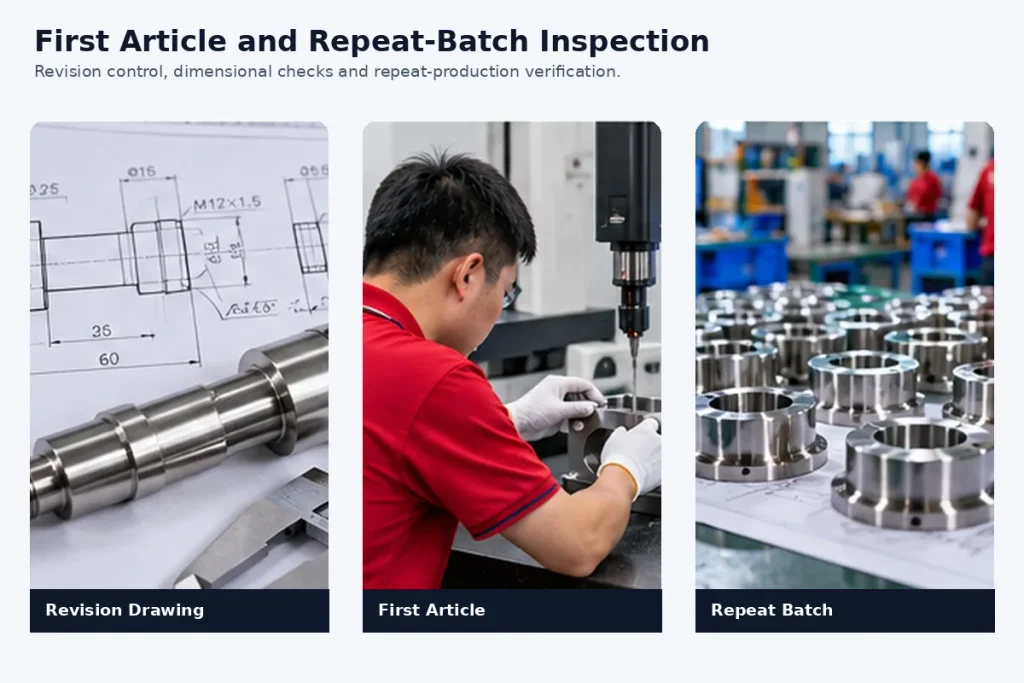
Yes, LuckyHXS can evaluate samples or prototypes followed by repeat production, provided the approved technical requirements remain controlled. A successful sample is useful evidence, but it does not by itself guarantee that every later batch will match.
Material-lot variation, tool wear, offsets, cutting heat, workholding, deburring, cleaning, finishing, measurement method, and drawing revisions can all affect repeatability. Before release, record the approved drawing revision, grade and condition, critical features, sample or first-article result, finish, and agreed inspection points.
For repeat batches, confirm how selected dimensions, threads, runout relationships, burrs, surface condition, and cleanliness will be monitored. If the material, drawing, quantity, finish, or inspection requirement changes, request another engineering review rather than assuming the original route remains valid.
12. What Information Is Needed for an Accurate Stainless Steel CNC Machining Quote?
An accurate quotation needs the latest part definition, exact material, quantity, critical requirements, and any finishing or documentation obligations. Price, MOQ, and lead time should then be confirmed for the actual project rather than taken from a generic promise.
Send the following where available:
- The latest 2D drawing with revision, dimensions, tolerances, datums, threads, and notes.
- A STEP, STP, or IGES model for geometry review.
- The exact stainless grade, standard, condition, and substitution restrictions.
- Sample quantity, first-batch quantity, and expected repeat volume.
- Critical fit, motion, sealing, runout, cleanliness, or cosmetic requirements.
- Surface finish, treatment, masking, and post-finish dimensional requirements.
- Inspection method, material-document, packaging, and delivery requirements.
- The operating environment when it affects material or finish selection.
Cost and schedule can change with stock availability, setup count, machining time, tool wear, tolerance, inspection, surface processing, documentation, and packing. Deep small holes, thin walls, difficult internal threads, long tool reach, several datum transfers, restricted deburring access, and cosmetic surfaces can add risk even when a part appears simple. A complete RFQ lets the manufacturing route, open questions, MOQ, price, and lead time be reviewed together.
Request an Engineering Review for Your Stainless Steel Part
Send LuckyHXS your latest drawing, CAD model, stainless grade, quantity, critical features, surface requirements, and inspection needs. The team can review whether CNC turning, milling, Swiss-type machining, turn-mill machining, or a combined route fits the geometry and identify the technical questions that must be resolved before quotation.
Upload your drawing and request a stainless steel CNC machining quote.