
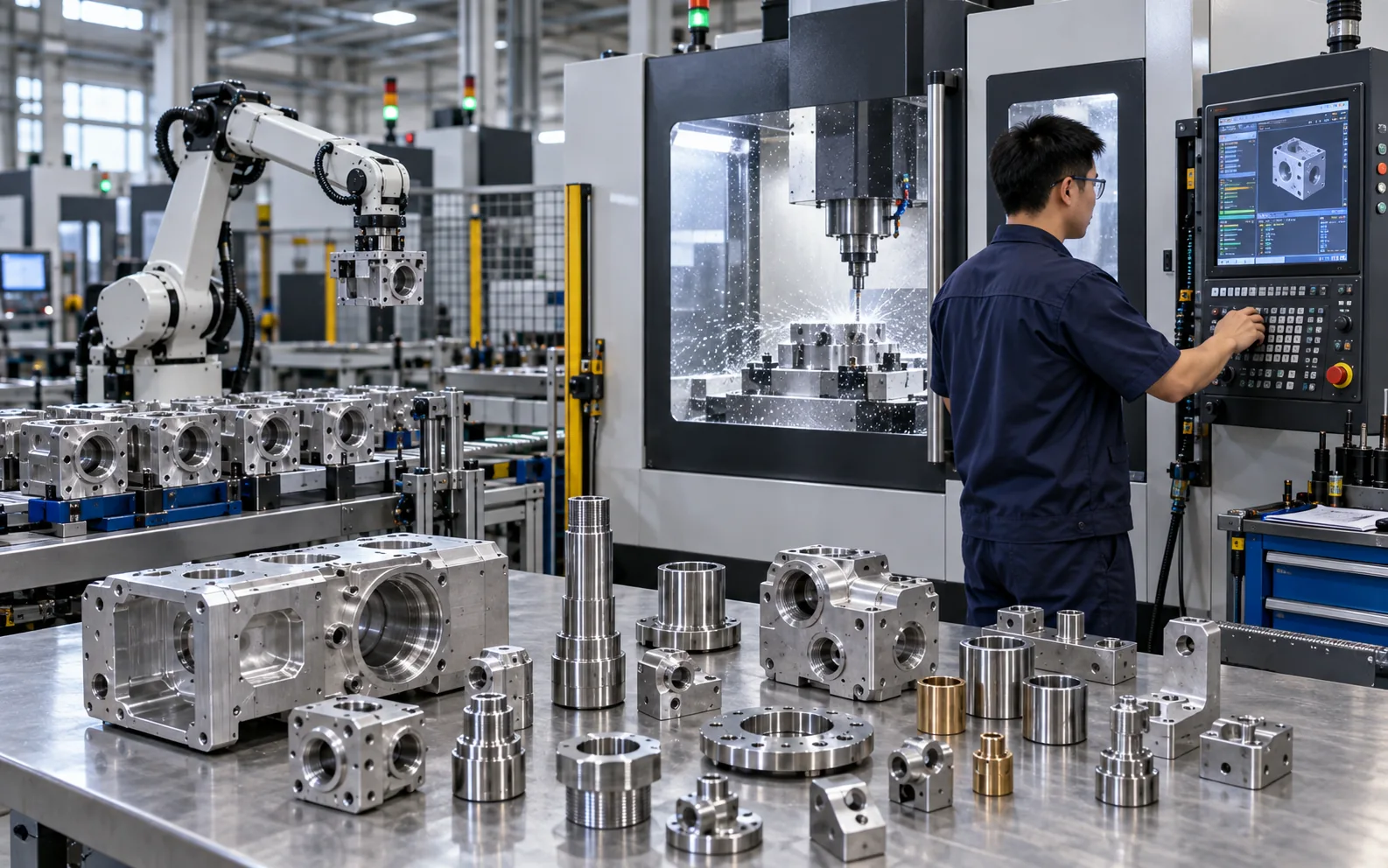
Automation and AI are reshaping CNC manufacturing by connecting design, programming, machining, inspection, and production planning into a faster, more predictable workflow. For buyers of CNC Machining Services, this means shorter lead times, better process control, more consistent part quality, and improved scalability. For manufacturers like Luckyhxs, AI-powered CNC machining supports smarter decisions without removing the need for skilled engineering judgment.
Video Guide: This video provides a broad overview of how AI is influencing modern manufacturing systems, making it a strong foundation before exploring CNC-specific applications.
What Is AI in CNC Machining for CNC Machining Services?
AI in CNC machining refers to the use of intelligent software, machine data, automation systems, and predictive algorithms to improve programming, production, toolpath optimization, machining stability, and inspection. In CNC Machining Services, it helps manufacturers produce complex turned and milled parts with better repeatability, faster setup, and stronger quality control.
Video Guide: This video is relevant because it focuses directly on AI entering CNC machining workflows and how automation can influence shop-floor productivity.
What AI Adds to CNC Manufacturing
AI-powered CNC machining does not mean a machine independently understands every engineering requirement. Instead, AI supports specific tasks that traditionally required manual analysis, repeated testing, or operator experience. These tasks include recognizing machining patterns, recommending cutting parameters, detecting tool wear, reducing air cutting, and improving inspection decisions.
In automated CNC machining, AI is often combined with sensors, CAM software, machine monitoring systems, robotic loading, and automated quality inspection. This creates a more connected workflow from CAD model to finished component.
Common AI-enabled CNC functions include:
- AI CNC programming: Suggesting toolpaths, machining strategies, feeds, speeds, and operation sequencing.
- Process monitoring: Detecting vibration, spindle load changes, thermal drift, and tool wear.
- CNC automation: Using robots, pallet systems, and machine monitoring to reduce idle time.
- Automated quality inspection: Comparing measured dimensions against CAD or GD&T requirements.
- Production optimization: Improving scheduling, estimating cycle time, and reducing scrap.
- CNC Turning and Milling Services support: Helping maintain consistency across both rotational and prismatic part geometries.
Luckyhxs Pro Tip: We do not treat AI as a replacement for machining expertise. We use it as a decision-support layer, then validate toolpaths, tolerances, materials, and inspection plans through experienced engineering review.
How Does AI in CNC Machining Work?
AI in CNC machining works by collecting data from CAD/CAM systems, machines, cutting tools, sensors, inspection equipment, and previous jobs. The software analyzes patterns, predicts risks, recommends machining strategies, and supports automated decisions that improve cycle time, tool life, dimensional accuracy, and production consistency.
Video Guide: This video connects CAD modeling with automated machining, making it useful for understanding how digital design data becomes CNC production instructions.
From CAD Data to Intelligent Production Control
A typical AI-powered CNC machining workflow starts with a digital part model and ends with validated physical components. AI can support multiple stages, but each stage still requires engineering rules, machine constraints, material knowledge, and quality standards.
A practical AI-assisted CNC workflow usually follows these steps:
- CAD model review The system reads part geometry, features, holes, pockets, slots, threads, and surfaces that require machining.
- Manufacturability analysis AI or rule-based software identifies difficult features, tight tolerances, thin walls, deep cavities, and potential fixture challenges.
- CAM strategy recommendation The system suggests operations such as roughing, finishing, drilling, tapping, CNC turning, 3-axis milling, 4-axis milling, or 5-axis machining.
- Cutting parameter optimization Feeds, speeds, depths of cut, stepovers, and tool engagement can be adjusted based on material, cutter type, machine rigidity, and historical performance.
- Simulation and collision checking Automated verification helps detect tool collisions, fixture interference, overtravel, and inefficient machine motion.
- Machine monitoring Sensors track spindle load, vibration, acoustic signals, temperature, and axis behavior during production.
- Automated quality inspection CMMs, probes, vision systems, or in-machine measurement tools compare actual dimensions with design requirements.
- Continuous feedback Inspection and machine data are fed back into the process to improve future jobs.
Luckyhxs Pro Tip: Before relying on AI recommendations, we always confirm the manufacturing logic behind them. A good-looking toolpath can still fail if workholding, chip evacuation, cutter reach, or material behavior is not properly considered.
Is AI Going to Replace CNC Machinists?
AI will not fully replace CNC machinists in advanced manufacturing, but it will change what machinists do. Routine programming, monitoring, and inspection tasks will become more automated, while skilled professionals will focus more on process planning, troubleshooting, fixturing, optimization, machine setup, and quality validation.
Video Guide: This video addresses the direct concern of whether AI threatens machinist roles and helps frame the discussion around skill evolution rather than simple replacement.
Why Skilled Machinists Still Matter
CNC automation can reduce repetitive manual tasks, but real machining still involves many variables that require human judgment. Material inconsistencies, tool deflection, thermal expansion, fixture movement, chatter, burr formation, surface finish requirements, and tolerance stack-ups are not always solved automatically.
AI can recommend a feed rate, but an experienced machinist understands whether the setup is rigid enough to run it safely. AI can generate a toolpath, but a manufacturing engineer must confirm whether the sequence supports tolerance control. Automated quality inspection can detect deviation, but humans decide whether the cause is tool wear, setup error, temperature drift, or programming strategy.
Based on our internal data and market analysis, here is the breakdown:
| CNC Role Area | AI Impact | Human Expertise Still Needed |
|---|---|---|
| Basic toolpath generation | High | Strategy validation and edge-case review |
| Setup planning | Medium | Workholding, datum selection, and machine choice |
| Tool wear monitoring | High | Tool change policy and failure analysis |
| Fixture design | Low to Medium | Mechanical judgment and cutting-force awareness |
| Quality inspection | High | GD&T interpretation and root-cause analysis |
| Process troubleshooting | Medium | Experience with vibration, deformation, and material behavior |
| Customer engineering communication | Low | DFM discussion, tolerance negotiation, and application understanding |
Luckyhxs Pro Tip: The most valuable machinists in the AI era will be those who understand both cutting physics and digital workflows. We encourage teams to learn CAM, probing, inspection data, and machine monitoring—not just manual operation.
How Can AI Be Used in CNC Machining?
AI can be used in CNC machining for programming support, toolpath optimization, predictive maintenance, cutting parameter selection, automated quality inspection, production scheduling, quoting, and real-time machine monitoring. These applications help CNC Machining Services deliver faster turnaround, fewer defects, better traceability, and more stable production quality.
Video Guide: This video is useful for understanding the role of AI in CNC programming and how intelligent software may influence CAM decisions.
Practical AI Applications in CNC Shops
AI is most valuable when it solves specific manufacturing problems. In CNC Turning and Milling Services, it can improve both front-end engineering and shop-floor execution. The key is to apply AI where data is reliable, process rules are clear, and results can be measured.
High-value use cases include:
- AI CNC programming AI can assist with feature recognition, tool selection, machining sequence planning, and initial toolpath generation.
- Cycle time reduction Software can identify unnecessary retracts, long air-cutting moves, inefficient stepovers, and conservative cutting parameters.
- Predictive tool wear analysis Machine data can help estimate when tools are likely to wear out before they produce out-of-tolerance parts.
- Adaptive machining control Some systems adjust feed rates based on spindle load, cutting conditions, or tool engagement.
- Automated quality inspection AI-supported inspection can classify defects, compare measurement trends, and flag process drift.
- Smart quoting and manufacturability review Historical job data can help estimate cost, lead time, material usage, and machining complexity.
- Production scheduling AI can help prioritize jobs based on machine availability, setup time, due dates, material readiness, and inspection capacity.
Luckyhxs Pro Tip: We recommend starting AI adoption with measurable targets: scrap reduction, quote speed, tool life, inspection time, or cycle time. If the goal is vague, the return on automation becomes difficult to prove.
Is There a Future in CNC Machining?
Yes, CNC machining has a strong future because industries still need precise, durable, custom, and low-to-medium-volume metal and plastic components. Automation and AI will not eliminate CNC; they will make it faster, more connected, more data-driven, and more competitive for demanding production requirements.
Video Guide: This video is relevant because it discusses automated machining as a future-facing manufacturing model where metalworking and intelligent systems work together.
Why CNC Remains Essential
CNC machining continues to be critical because many products cannot be made economically or accurately through casting, molding, stamping, or additive manufacturing alone. Aerospace, medical devices, robotics, automotive, energy, electronics, and industrial equipment all rely on machined components with controlled tolerances and dependable material properties.
The future of CNC manufacturing will likely be defined by connected production cells, integrated inspection, AI-enhanced CAM, robotic loading, automated deburring, digital twins, and closed-loop quality feedback.
Key future trends include:
- More lights-out machining Robotic loading, pallet pools, tool monitoring, and automated inspection will allow longer unattended production windows.
- Stronger integration between CAD, CAM, and inspection Design intent, machining strategy, and measurement results will become more connected.
- Greater demand for high-mix, low-volume production CNC Machining Services will remain valuable for prototypes, custom parts, replacement components, and specialized production.
- Expanded use of hybrid manufacturing CNC will increasingly work alongside additive manufacturing, laser processing, and advanced surface finishing.
- Higher expectations for data traceability Customers will want process records, inspection reports, material certificates, and repeatable manufacturing documentation.
Luckyhxs Pro Tip: The future belongs to CNC suppliers that combine automation with engineering flexibility. Fast machines matter, but the real advantage comes from reliable quoting, strong DFM support, stable quality systems, and responsive communication.
Key Features & Comparison
The most important features of AI-powered CNC machining include automated programming support, intelligent process monitoring, tool wear prediction, adaptive optimization, robotic handling, and automated quality inspection. Compared with traditional CNC workflows, these capabilities improve consistency, reduce manual workload, shorten lead times, and support better production decisions.
Video Guide: This video is relevant because it discusses realistic expectations for AI in CNC machining, which is helpful when comparing benefits and limitations.
Traditional CNC vs AI-Powered CNC Manufacturing
Based on our internal data and market analysis, here is the breakdown:
| Feature | Traditional CNC Machining | AI-Powered CNC Machining | Practical Benefit |
|---|---|---|---|
| Programming | Manual CAM decisions depend heavily on programmer experience | AI CNC programming assists with feature recognition and toolpath suggestions | Faster programming for repeatable part families |
| Setup optimization | Based on past experience and manual planning | Data-supported setup recommendations and simulation | Lower setup risk and fewer trial cuts |
| Cutting parameters | Often conservative or manually adjusted | Optimized using material, tool, and machine data | Better cycle time and tool life |
| Machine monitoring | Operator checks machine condition manually | Sensors track load, vibration, temperature, and anomalies | Earlier detection of process instability |
| Tool wear management | Scheduled changes or visual inspection | Predictive wear models estimate tool condition | Reduced scrap and fewer unexpected failures |
| Quality inspection | Manual inspection or post-process CMM checks | Automated quality inspection with trend analysis | Faster feedback and improved consistency |
| Production scheduling | Manual planning with limited real-time visibility | AI-supported planning using capacity and job data | Better machine utilization |
| Scalability | Dependent on operator availability | More compatible with robotic loading and lights-out production | Higher throughput with stable processes |
AI-powered CNC machining is not automatically superior in every situation. For very simple one-off parts, traditional programming may still be efficient. However, for repeat production, complex geometries, tight tolerances, multi-operation components, and demanding delivery schedules, automation can significantly improve performance.
The strongest results usually come from combining CNC automation with disciplined engineering practices: clear drawings, realistic tolerances, validated materials, stable workholding, controlled tooling, and reliable inspection standards.
Luckyhxs Pro Tip: When evaluating a CNC supplier, do not only ask whether they use automation. Ask how they validate the process, control inspection, handle revisions, and prevent nonconforming parts from reaching shipment.
Cost & Buying Factors
The cost of AI-powered CNC machining depends on material, part complexity, tolerance requirements, order volume, surface finish, inspection needs, machine type, and setup time. Automation can reduce cost in repeat production, but highly complex prototypes may still require careful engineering review and manual process planning.
What Influences CNC Machining Service Pricing
CNC Machining Services are priced according to both direct machining time and the engineering work needed to produce parts correctly. AI and automation can reduce some costs, especially when jobs are repeatable, but they do not remove the need for setup, tooling, inspection, and quality control.
Major cost factors include:
- Material type Aluminum, stainless steel, brass, copper, titanium, engineering plastics, and hardened alloys all have different machining speeds, tool wear rates, and material costs.
- Part geometry Deep pockets, thin walls, small radii, complex contours, and multi-axis features increase programming and machining difficulty.
- Tolerance requirements Tight tolerances require more careful setup, stable machining conditions, slower finishing passes, and additional inspection.
- Order quantity Higher volumes spread setup cost across more parts and make CNC automation more cost-effective.
- Surface finish Fine finishes may require additional finishing passes, polishing, anodizing, plating, bead blasting, or other post-processing.
- Inspection level Basic dimensional checks cost less than full CMM reports, first article inspection, material certification, or production traceability documentation.
- Lead time Expedited production may require schedule priority, additional labor, or dedicated machine capacity.
A practical buying guide:
| Buying Factor | Lower-Cost Scenario | Higher-Cost Scenario |
|---|---|---|
| Material | Aluminum or common plastics | Titanium, Inconel, hardened steel, copper alloys |
| Geometry | Simple 2.5D milling or basic turning | 5-axis contours, thin walls, deep cavities |
| Tolerance | General machining tolerances | Precision fits, flatness, concentricity, GD&T controls |
| Quantity | Repeat batch production | One-off prototype with complex setup |
| Inspection | Basic dimensional check | CMM report, FAI, traceability package |
| Finish | As-machined | Anodizing, plating, polishing, passivation |
| Delivery | Standard lead time | Urgent production or schedule acceleration |
Luckyhxs Pro Tip: To get a more accurate quote, we recommend sending both 3D CAD files and 2D drawings. The CAD model shows geometry, but the drawing communicates tolerances, threads, surface finish, material, and inspection requirements.
Conclusion
Automation and AI are transforming CNC manufacturing by improving programming speed, process stability, machine utilization, and inspection reliability. The best results come when intelligent tools support experienced engineers and machinists. For customers, this means faster CNC Machining Services, better consistency, and stronger quality control.
What Buyers Should Take Away
AI in CNC machining is not just a future concept—it is already influencing how parts are quoted, programmed, machined, inspected, and delivered. However, the most reliable manufacturing outcomes still depend on strong fundamentals: good design data, proper material selection, realistic tolerances, experienced process planning, and disciplined quality control.
For companies sourcing CNC Turning and Milling Services, the ideal supplier should offer both advanced capability and practical manufacturing judgment.
Before choosing a CNC partner, consider:
- Can they review manufacturability before production?
- Do they support both CNC turning and milling?
- Can they handle prototypes and repeat production?
- Do they provide appropriate inspection reports?
- Do they understand tolerance, material, and finish requirements?
- Can they scale production with automation when needed?
- Do they communicate clearly about risks, lead time, and cost drivers?
Luckyhxs combines CNC manufacturing experience with modern automation practices to help customers produce precise, reliable components for prototypes, custom parts, and production runs.
Luckyhxs Pro Tip: If you want better CNC results, involve your machining supplier early. A short DFM review before production can often reduce cost, prevent tolerance problems, and improve delivery reliability.