
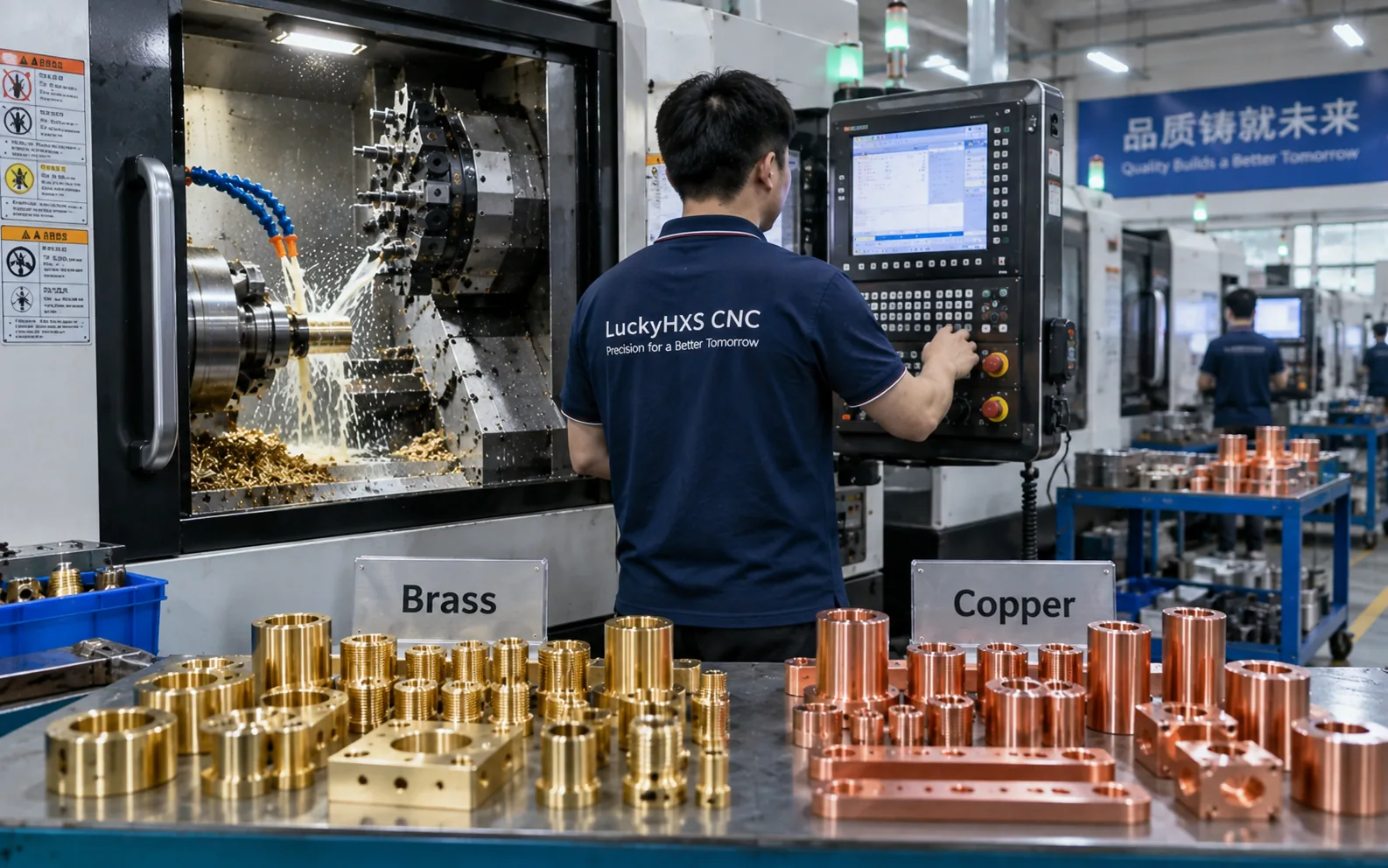
Choosing between brass and copper for CNC machining comes down to the part’s electrical performance, corrosion environment, mechanical load, appearance, and production cost. Copper offers superior conductivity and thermal transfer, while brass usually provides easier machining, better dimensional stability, and lower tool wear. For precision brass and copper parts, the best material is the one that matches both performance requirements and manufacturing realities.
Brass and Copper CNC Parts: Materials, Properties & Applications
Brass and copper CNC parts are precision-machined components made from copper-based metals for electrical, mechanical, fluid, decorative, and industrial applications. Brass CNC machining is often selected for easy cutting and stable tolerances, while copper machining is preferred when maximum electrical or thermal conductivity is required.
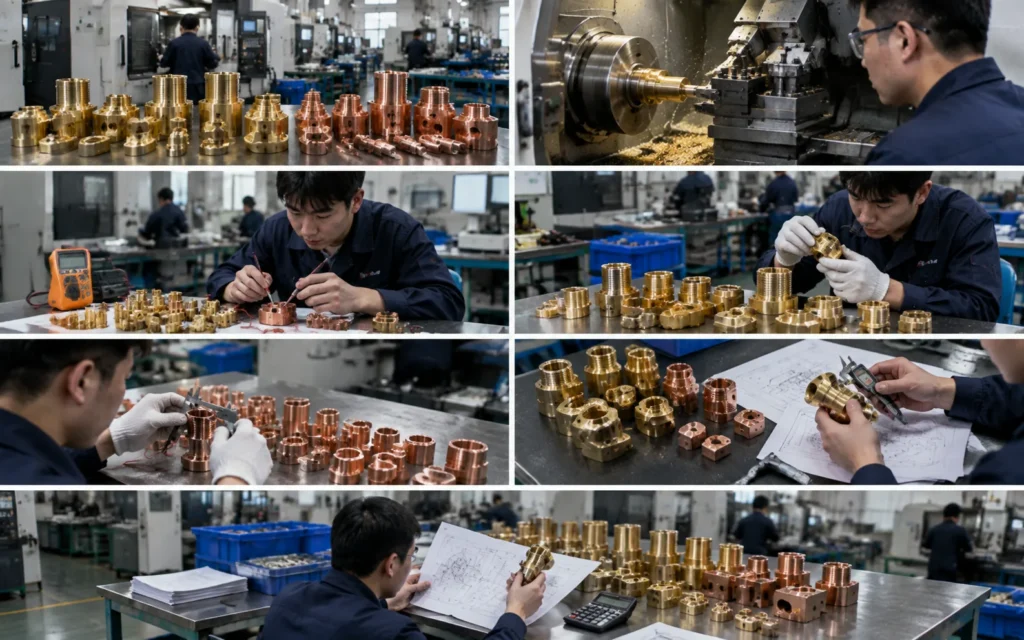
Material Families and Typical CNC Part Types
Brass is primarily an alloy of copper and zinc, sometimes with small additions of lead, tin, or other elements to improve machinability, strength, or corrosion resistance. Copper is usually selected in commercially pure or high-conductivity grades when electrical or thermal performance is the priority.
Common brass and copper CNC parts include terminals, connectors, bushings, fittings, valve components, heat-transfer parts, threaded inserts, sensor housings, turned pins, electrical contacts, and custom precision components.
Based on our internal data and market analysis, here is the breakdown:
| Category | Brass CNC Parts | Copper CNC Parts |
|---|---|---|
| Main composition | Copper + zinc alloy | Mostly copper |
| Typical strength | Moderate to good | Lower to moderate, depending on grade |
| Machinability | Excellent, especially free-cutting brass | Fair to challenging due to softness and ductility |
| Conductivity | Moderate | Excellent |
| Common processes | CNC turning, milling, drilling, threading | CNC milling, turning, drilling, EDM support |
| Typical applications | Fittings, fasteners, inserts, decorative parts | Busbars, contacts, heat sinks, RF components |
| Surface finishing | Nickel plating, tin plating, polishing | Nickel plating, silver plating, tin plating, passivation |
Luckyhxs Pro Tip: When customers ask me whether to choose brass or copper for machined parts, I first check the conductivity requirement. If the part does not need near-pure copper performance, brass often gives a better balance of cost, machinability, and dimensional control.
CNC Machining Process for Brass and Copper Parts
Brass and copper CNC machining works by removing material from bar stock, plate, rod, or billet using controlled cutting tools. CNC turning creates round parts, CNC milling forms complex profiles, and secondary finishing such as nickel plating improves wear resistance, corrosion protection, solderability, and appearance.
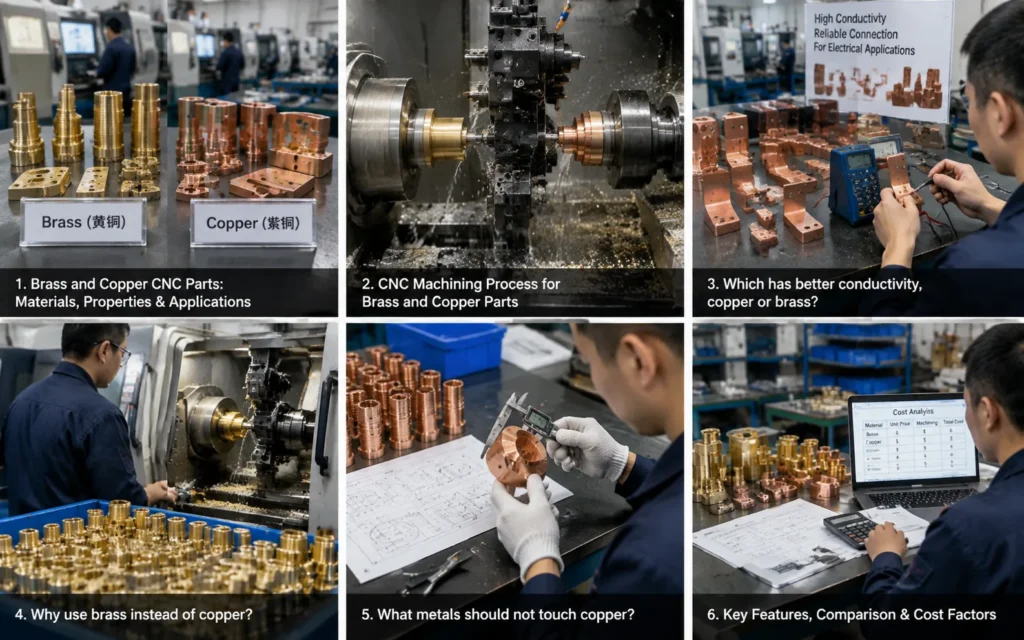
CNC Manufacturing Flow for Brass and Copper Components
The machining process begins with material selection and continues through programming, cutting, inspection, finishing, and packaging. Brass generally cuts cleanly and supports faster cycle times, while copper requires sharper tools, optimized chip evacuation, and careful heat control.
A typical production workflow includes:
- Material selection
Choose brass, copper, or a specific alloy grade based on conductivity, strength, corrosion resistance, cost, and finishing needs. - DFM review
Check wall thickness, tolerance stack-up, hole depth, thread design, burr risk, and plating allowance. - CNC programming
Create toolpaths for turning, milling, drilling, boring, grooving, chamfering, and threading. - Machining operation
Use controlled speeds, feeds, coolant, and tool geometry to maintain accuracy and surface quality. - Deburring and cleaning
Remove sharp edges, chips, oil, and residues before inspection or plating. - Surface finishing
Apply nickel plating for brass and copper parts when improved corrosion resistance, hardness, soldering protection, or cosmetic uniformity is required. - Inspection and packaging
Verify dimensions, threads, surface finish, plating thickness, conductivity requirements, and visual quality.
Luckyhxs Pro Tip: For copper parts, I avoid treating the machining parameters like aluminum or brass. Copper’s softness can cause built-up edge and poor chip control, so sharp carbide tools, stable clamping, and coolant strategy make a major difference.
Which has better conductivity, copper or brass?
Copper has significantly better electrical conductivity and thermal conductivity than brass. Pure copper is the standard choice for high-current, heat-transfer, grounding, and electrical contact applications. Brass still conducts electricity, but its zinc content lowers conductivity, making it better for structural, threaded, or cost-sensitive parts.
Conductivity Differences in Practical Applications
Copper is widely used when current flow or heat dissipation is critical. Brass contains zinc and sometimes other alloying elements, which improve machinability and strength but reduce conductivity. This means brass may be suitable for low-to-moderate electrical duties, while copper is preferred for demanding power, thermal, and signal performance.
Based on our internal data and market analysis, here is the breakdown:
| Property | Copper | Brass |
|---|---|---|
| Electrical conductivity | Very high | Moderate |
| Thermal conductivity | Very high | Moderate |
| Best use case | Busbars, terminals, heat sinks, contacts | Connectors, fittings, threaded inserts, housings |
| Machining difficulty | Higher | Lower |
| Cost efficiency in machining | Lower due to slower cutting and tool control | Higher due to faster cutting |
| Dimensional stability during cutting | More challenging | More predictable |
| Suitability for decorative plating | Good | Excellent |
Copper is usually selected for:
- Electrical contacts and terminals
- Power distribution components
- Heat sinks and thermal spreaders
- RF and grounding components
- Battery and EV-related conductive parts
Brass is usually selected for:
- Threaded connectors
- Pneumatic and hydraulic fittings
- Bushings and inserts
- Decorative hardware
- Precision brass and copper turned parts where strength and machinability matter more than maximum conductivity
Luckyhxs Pro Tip: If a drawing only says “conductive copper alloy,” I always confirm the required conductivity percentage or IACS value before quoting. Without that number, the customer may expect copper performance from a brass-like alloy, which can cause design problems later.
Why use brass instead of copper?
Brass is often used instead of copper because it machines faster, holds threads well, resists galling, offers better rigidity, and usually lowers production cost. For CNC-machined fittings, inserts, fasteners, and decorative parts, brass provides a practical balance of strength, appearance, corrosion resistance, and manufacturability.
Reasons Brass Is Often the Better Machining Choice
Brass CNC machining is popular because brass forms manageable chips, allows high cutting speeds, produces excellent surface finishes, and supports reliable threading. In many mechanical applications, pure copper’s conductivity advantage is unnecessary, while its machining challenges add cost.
Key reasons to choose brass include:
- Superior machinability
Free-cutting brass can be machined quickly with clean chips and less tool stress. - Better threaded performance
Brass holds internal and external threads well, making it ideal for fittings and inserts. - Good corrosion resistance
Brass performs well in many indoor, water, air, and mild industrial environments. - Attractive appearance
Brass can be polished, brushed, nickel plated, chrome plated, or left with a natural gold tone. - Lower machining cost
Faster cycle times and easier chip control often reduce the final part cost. - Improved stiffness compared with pure copper
Brass is generally less gummy and more stable during cutting. - Excellent finishing compatibility
Nickel plating for brass and copper parts is common, but brass often plates very consistently when properly cleaned.
However, brass is not always the right substitute. If the component must carry high current, dissipate heat efficiently, or meet a specific conductivity standard, copper is usually the better option.
Luckyhxs Pro Tip: I recommend brass when the part is mainly mechanical and copper when the part is mainly electrical or thermal. That simple rule prevents many over-engineered and overpriced CNC projects.
What metals should not touch copper?
Copper should not directly contact certain dissimilar metals in wet, salty, acidic, or conductive environments because galvanic corrosion may occur. Aluminum, carbon steel, zinc, and some magnesium alloys are common concerns. Proper isolation, plating, sealing, or material pairing can reduce corrosion risk.
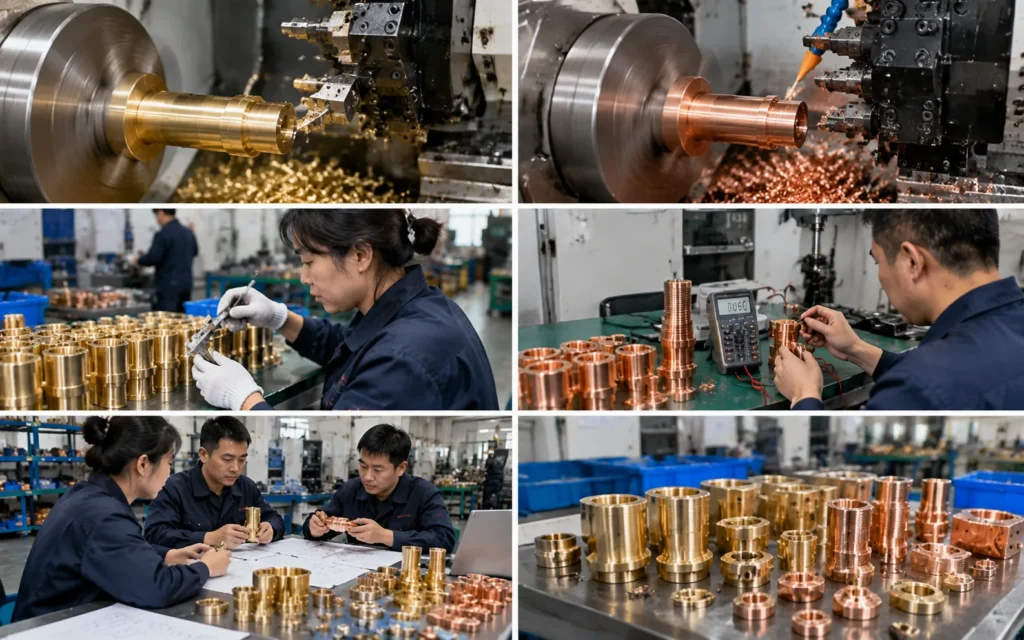
Galvanic Compatibility and Material Pairing
Galvanic corrosion happens when two different metals are electrically connected in the presence of an electrolyte such as water, salt spray, coolant, or condensation. One metal becomes more anodic and corrodes faster, while the more noble metal is protected.
Based on our internal data and market analysis, here is the breakdown:
| Metal in Contact with Copper | Risk Level | Common Issue | Recommended Control |
|---|---|---|---|
| Aluminum | High in wet/salty environments | Aluminum corrosion near copper contact | Use insulation, coating, sealant, or plated barrier |
| Carbon steel | Medium to high | Steel rusting and staining | Add plating, paint, gasket, or isolation washer |
| Zinc / galvanized steel | High | Zinc sacrificial corrosion | Avoid direct wet contact or use barrier layer |
| Magnesium alloys | Very high | Rapid corrosion of magnesium | Avoid direct contact in most service conditions |
| Stainless steel | Low to medium | Depends on grade and environment | Use passivation, sealing, and drainage design |
| Brass | Generally compatible | Lower risk due to copper base | Still consider dezincification conditions |
| Nickel | Generally compatible | Often used as barrier plating | Control plating thickness and porosity |
For brass and copper CNC parts, nickel plating is often used as a functional barrier. It can improve wear resistance, slow oxidation, provide a more uniform appearance, and reduce direct contact between incompatible materials.
Good design practices include:
- Use non-conductive washers or bushings between incompatible metals.
- Specify nickel, tin, or other barrier plating where appropriate.
- Avoid trapped moisture around metal interfaces.
- Add drainage, ventilation, or sealing in outdoor assemblies.
- Confirm compatibility with coolants, chemicals, and cleaning agents.
- Consider salt spray or humidity testing for harsh environments.
Luckyhxs Pro Tip: I never evaluate galvanic corrosion by material names alone. I ask where the part will be used, whether moisture is present, and what other metals are in the assembly. Environment is what turns a harmless contact into a corrosion failure.
Key Features & Comparison
Brass and copper differ most in machinability, conductivity, mechanical behavior, and cost. Brass is easier and faster to machine, making it ideal for precision turned parts and fittings. Copper delivers much better electrical and thermal performance, making it preferred for conductive and heat-transfer components.
CNC Machining Performance Comparison
Based on our internal data and market analysis, here is the breakdown:
| Feature | Brass | Copper | Practical Recommendation |
|---|---|---|---|
| Machinability | Excellent | Moderate to difficult | Choose brass for high-volume turned parts |
| Electrical conductivity | Moderate | Excellent | Choose copper for current-carrying parts |
| Thermal conductivity | Moderate | Excellent | Choose copper for heat-transfer parts |
| Tool wear | Low to moderate | Moderate, depending on grade and setup | Use sharp tools and optimized coolant for copper |
| Surface finish | Excellent | Good, but can smear if tools are dull | Brass is easier for cosmetic machining |
| Thread quality | Very good | Good, but softer threads may deform | Brass is preferred for durable threaded inserts |
| Corrosion resistance | Good | Good, but oxidizes visibly | Use plating when appearance or protection matters |
| Nickel plating suitability | Excellent | Excellent with correct pretreatment | Use nickel for barrier, wear, and cosmetic needs |
| Raw material cost | Usually lower than copper | Usually higher | Brass often wins on total part cost |
| Best applications | Fittings, inserts, bushings, valves | Terminals, busbars, contacts, heat sinks | Match material to function |
When comparing brass vs copper machinability, brass usually wins because it cuts cleanly, supports faster feeds and speeds, and reduces burr formation. When comparing brass vs copper conductivity, copper wins by a wide margin, especially in electrical and thermal applications.
Important selection criteria include:
- Required electrical conductivity
- Required thermal conductivity
- Mechanical load and thread strength
- Corrosion environment
- Plating or finishing requirements
- Annual production volume
- Tolerance and surface finish
- Assembly contact with other metals
- Target unit price
Luckyhxs Pro Tip: For production quotes, I look beyond raw material price. A copper blank may be only one part of the cost; slower machining, tool control, deburring, and inspection can make the finished copper part much more expensive than brass.
Cost & Buying Factors
The cost of brass and copper CNC parts depends on material grade, part geometry, tolerance, quantity, finishing, inspection requirements, and plating. Brass is often more economical for machined mechanical parts, while copper costs more when conductivity requirements, tight tolerances, or complex features increase machining difficulty.
Pricing Drivers for Precision Brass and Copper Parts
The final price of brass and copper CNC parts is influenced by both material cost and process cost. Copper generally has a higher raw material cost and can require slower machining. Brass often offers shorter cycle times, easier tool control, and more stable production output.
Key buying factors include:
- Material grade
Copper grades and brass alloys vary in cost, strength, conductivity, and machinability. - Part complexity
Deep holes, thin walls, fine threads, tight grooves, and undercuts increase machining time. - Tolerance level
Precision brass and copper parts with tight tolerances require slower cutting, better fixturing, and more inspection. - Surface finish
Polishing, brushing, passivation, tin plating, silver plating, and nickel plating all affect cost. - Plating thickness and specification
Nickel plating for brass and copper parts may require controlled thickness, adhesion testing, and masking. - Order quantity
Higher quantities reduce setup cost per part and can justify custom fixtures or automated turning. - Inspection requirements
CMM reports, material certificates, plating reports, conductivity testing, and RoHS/REACH documentation add value and cost. - Lead time
Urgent production may require priority scheduling, express material sourcing, or overtime.
Based on our internal data and market analysis, here is the breakdown:
| Buying Factor | Cost Impact | Notes |
|---|---|---|
| Brass instead of copper | Often lowers cost | Best when high conductivity is not required |
| Copper high-conductivity grade | Raises cost | Needed for electrical and thermal performance |
| Tight tolerances | Raises cost | More inspection and slower machining |
| Nickel plating | Moderate cost increase | Adds protection, wear resistance, and appearance |
| High production volume | Lowers unit cost | Setup cost spreads across more parts |
| Complex turned geometry | Raises cost | More tools, operations, and cycle time |
| Deburring requirements | Can raise cost | Copper burrs may need careful manual or controlled finishing |
Luckyhxs Pro Tip: To get the most accurate quote, send a 2D drawing, 3D CAD file, material grade, tolerance requirements, annual quantity, and finishing specification. If plating is required, I also need masking areas and plating thickness.
Conclusion
Brass is usually the better CNC machining choice for cost-effective mechanical parts, threaded components, fittings, and high-volume turned parts. Copper is the better choice for electrical conductivity, thermal transfer, and power-related applications. The right decision depends on function, environment, tolerance, finishing, and total production cost.
Practical Selection Guidance
For most buyers, the decision between brass or copper for machined parts should start with performance requirements. If the part must conduct electricity or transfer heat efficiently, copper is usually the correct material. If the part must be easy to machine, dimensionally stable, strong enough for threads, and cost-effective, brass is often the smarter choice.
Use this simple selection list:
- Choose copper for busbars, electrical terminals, RF parts, heat sinks, grounding parts, and high-conductivity components.
- Choose brass for fittings, inserts, bushings, valves, fasteners, decorative hardware, and high-volume brass and copper turned parts.
- Choose nickel plating when corrosion protection, wear resistance, barrier performance, or a bright uniform finish is required.
- Request DFM support when tolerances are tight, copper walls are thin, or plating dimensions are critical.
- Confirm galvanic compatibility if copper or brass will contact aluminum, steel, zinc, or other metals in wet environments.
Luckyhxs supports brass CNC machining, copper CNC machining, brass and copper turned parts, precision brass and copper parts, and nickel plating coordination for demanding industrial applications. With the right material and process plan, you can improve part performance while controlling cost and lead time.
Luckyhxs Pro Tip: If you are unsure which material to use, send the drawing and application details first. I can usually identify whether brass, copper, or a plated copper alloy will give the best balance of conductivity, machinability, and cost.