
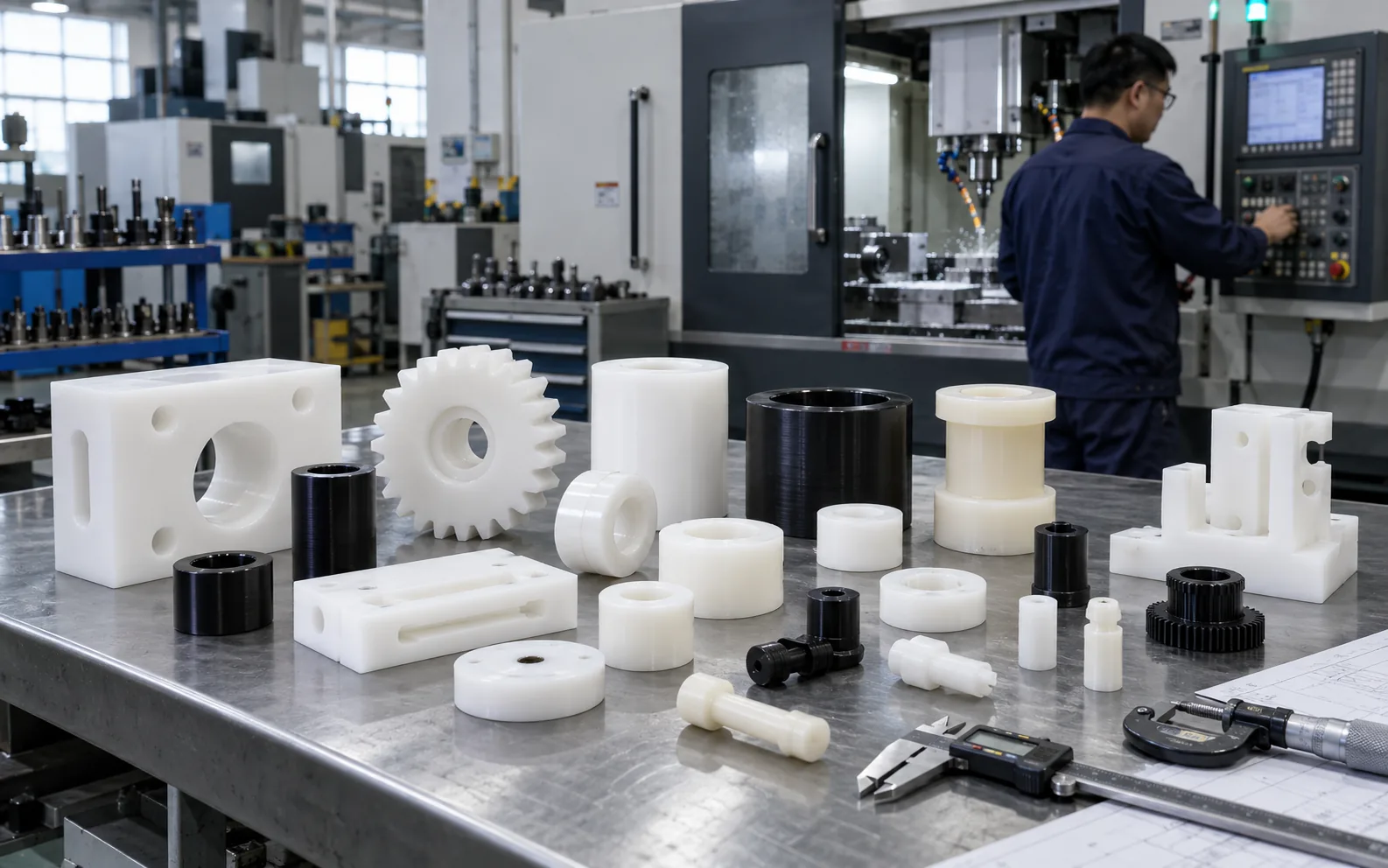
POM is a preferred engineering plastic for tight-tolerance components because it combines low friction, high stiffness, good wear resistance, and reliable machinability. For buyers and engineers, the main challenges are controlling POM machining tolerances, reducing POM machining warping, and preserving POM dimensional stability from raw stock to final inspection. Luckyhxs focuses on practical CNC strategies that help achieve repeatable, production-ready plastic parts.
POM CNC Machined Parts: Properties & Applications
POM CNC machined parts are precision components made from acetal material using milling, turning, Swiss machining, drilling, boring, and finishing processes. They are widely used where low friction, dimensional repeatability, chemical resistance, and tight plastic machining tolerances are required, especially in gears, bushings, rollers, guides, and functional mechanical parts.
Material Definition and Typical Applications
POM, also known as acetal or polyoxymethylene, is a semi-crystalline engineering plastic valued for its stability, fatigue resistance, and smooth machinability. Compared with many softer plastics, POM produces cleaner chips and holds geometry well when proper cutting parameters, fixturing, and stress-relief practices are used.
Common POM CNC machined parts include:
- Bushings and bearing sleeves for low-friction motion
- Precision rollers, wheels, and guide blocks
- Electrical insulators and structural plastic housings
- Small POM CNC turned parts such as pins, spacers, and valve components
- Precision plastic Swiss machined parts for medical, electronics, and automation assemblies
- POM CNC milling parts with pockets, slots, counterbores, and complex 3-axis or 4-axis features
POM is often selected when metal is too heavy, too conductive, or unnecessary for the load condition. It is also preferred when the part must resist moisture better than nylon while maintaining smooth movement against mating surfaces.
Luckyhxs Pro Tip: I recommend confirming whether your application needs POM-H or POM-C before quoting. Copolymer POM is often better for general dimensional stability and chemical exposure, while homopolymer POM may offer slightly higher stiffness for specific mechanical designs.
POM CNC Machining Process for Tolerance and Warping Control
POM CNC machining works by removing material from acetal stock with controlled cutting speed, sharp tools, stable fixturing, and staged machining. The goal is to reduce heat, prevent stress release, control chip evacuation, and finish critical dimensions only after roughing, resting, and inspection steps have stabilized the plastic workpiece.
Machining Flow for Stable POM Components
POM machining is not simply “cutting plastic like metal.” The process must account for thermal expansion, internal stock stress, part geometry, wall thickness, and clamping pressure. Excessive heat or aggressive material removal can lead to distortion after the part is unclamped.
A typical stable production workflow includes:
- Material review
Confirm POM grade, stock size, color, certification needs, and whether the part requires FDA, RoHS, or industry-specific documentation. - DFM analysis
Check thin walls, sharp inside corners, deep pockets, long unsupported features, and tolerance stack-ups that may increase POM machining warping risk. - Rough machining
Remove bulk material with balanced passes while leaving stock allowance for finishing. - Rest or stress-relief interval
Allow the part to relax before final machining, especially for large, flat, or asymmetric components. - Semi-finish machining
Bring the part close to final geometry while controlling temperature and tool pressure. - Final finishing
Machine critical holes, bores, slots, and sealing surfaces with sharp tools and light cuts. - Inspection and stabilization check
Measure after the part reaches room temperature and, when needed, verify dimensional repeatability after a defined waiting period.
Luckyhxs Pro Tip: I avoid finishing tight-tolerance POM features immediately after heavy roughing. Letting the material rest before final passes is one of the simplest ways to reduce post-machining movement and improve inspection consistency.
Benefits of POM CNC Machined Parts
The main benefits of POM CNC machining are excellent wear resistance, low friction, good machinability, low moisture absorption, stable mechanical performance, and cost-effective precision for functional plastic components. With the right process, POM offers reliable tolerances and smooth finishes for prototypes, bridge production, and end-use parts.
Performance Advantages for Functional Plastic Parts
POM is frequently used when engineers need a plastic part that behaves predictably in mechanical assemblies. It is stronger and more dimensionally stable than many commodity plastics, yet easier to machine than several high-performance polymers.
Based on our internal data and market analysis, here is the breakdown:
| Benefit | Why It Matters | Typical Application Impact |
|---|---|---|
| Low friction | Reduces sliding resistance | Bushings, rollers, guides, cams |
| Good dimensional stability | Supports repeatable assembly fit | Housings, spacers, precision blocks |
| Low moisture absorption | Performs better than nylon in humid environments | Outdoor mechanisms, fluid-adjacent parts |
| Clean machinability | Allows crisp edges and accurate bores | POM CNC milling and turning |
| Good fatigue resistance | Handles repeated mechanical cycling | Gears, levers, moving components |
| Electrical insulation | Useful in non-conductive assemblies | Electronics fixtures and insulators |
POM also offers strong value for custom CNC machining services because it can be processed quickly with sharp tools and efficient cycle times. For small shafts, collars, micro bushings, and high-volume miniature parts, precision plastic Swiss machined parts can deliver excellent repeatability with reduced secondary handling.
Luckyhxs Pro Tip: I often suggest POM when a customer wants smoother motion without adding bearings or coatings. If the design load is reasonable, a well-machined POM surface can simplify the assembly and reduce long-term maintenance.
How to Maintain POM CNC Machined Parts
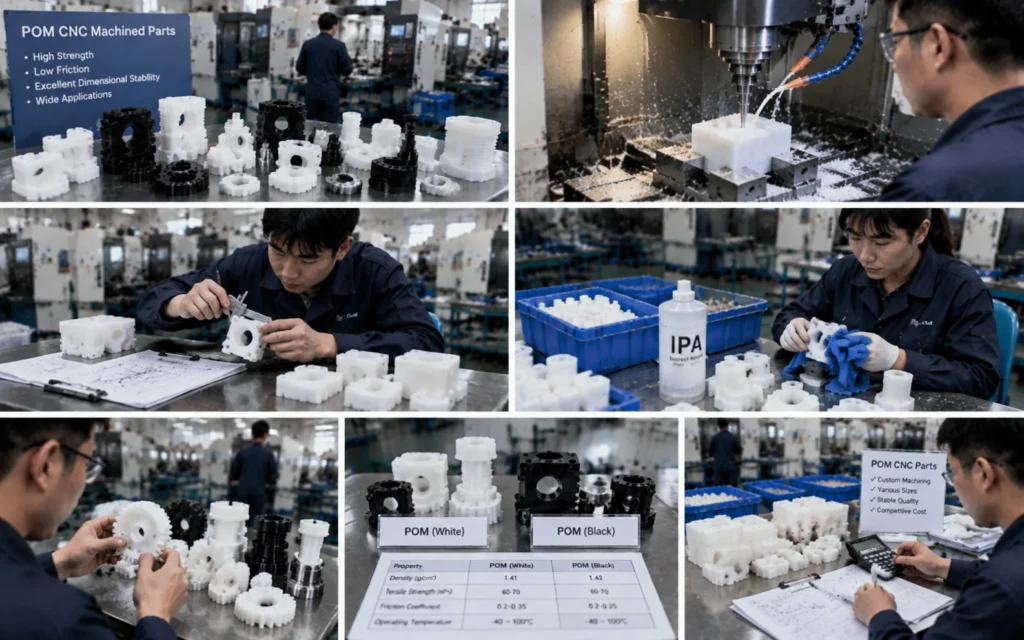
Maintaining POM CNC machined parts means protecting them from excessive heat, aggressive solvents, over-tightened fasteners, abrasive contamination, and unsupported mechanical loads. Proper storage, inspection, cleaning, and assembly control help preserve POM dimensional stability and prevent warping, cracking, creep, or premature wear in service.
Handling, Storage, and In-Service Care
POM is durable, but it is still a thermoplastic. Dimensional performance depends on how the finished component is stored, installed, and used. Parts should not be treated like metal components during torqueing, cleaning, or thermal exposure.
Recommended maintenance practices include:
- Store parts flat and supported
Large or thin POM components should be supported evenly to avoid gradual bending. - Avoid high-temperature exposure
Keep parts away from heat sources that may cause expansion, softening, or shape change. - Use compatible cleaners
Mild detergents and approved plastic-safe cleaners are preferred; avoid harsh chemical exposure unless compatibility is verified. - Control fastener torque
Over-tightening screws can distort bores, countersinks, and thin-wall features. - Inspect wear surfaces
Check sliding faces, guide tracks, bushings, and rotating interfaces for scoring or embedded debris. - Prevent abrasive contamination
Dust, metal chips, and hard particles can accelerate wear on low-friction plastic surfaces. - Allow parts to stabilize before final measurement
If parts move from a hot shop floor to a cool inspection room, wait before confirming critical dimensions.
For precision assemblies, maintenance also includes checking mating components. A perfectly machined POM bushing may still fail early if the shaft is rough, misaligned, contaminated, or outside tolerance.
Luckyhxs Pro Tip: I always ask customers how the part will be clamped or fastened in the final assembly. Many “material problems” are actually caused by excessive screw load or unsupported thin sections.
POM CNC Machining Cost & Pricing Factors
The price of POM CNC machined parts depends on material grade, part size, tolerance requirements, geometry complexity, surface finish, production quantity, inspection level, and secondary operations. Simple POM CNC turned parts may be economical, while tight-tolerance Swiss machined or complex milled parts require more programming, fixturing, and quality control.
Pricing Drivers for Custom POM Machining
POM is generally cost-effective compared with many advanced engineering plastics, but machining price varies widely by design and production requirements. Tight tolerances, thin walls, deep pockets, and post-machining stability checks can increase cost because they require slower machining and additional process control.
Based on our internal data and market analysis, here is the breakdown:
| Cost Factor | Lower-Cost Condition | Higher-Cost Condition |
|---|---|---|
| Part geometry | Simple turned spacers or blocks | Complex 3D milled features, thin walls, deep pockets |
| Tolerance | General plastic tolerance | Tight POM machining tolerances on bores, slots, or datums |
| Quantity | Batch production with repeat setup | One-off prototypes with full programming time |
| Material | Standard black or natural POM | Certified, specialty, or oversized stock |
| Inspection | Basic dimensional check | Full inspection report, CMM, first article inspection |
| Warping control | Thick, balanced geometry | Large flat parts, asymmetric stock removal |
| Surface finish | Standard machined finish | Polished, deburred, cosmetic, or special edge requirements |
For quoting, the most useful files are a 3D CAD model, 2D drawing with tolerances, material specification, quantity, application notes, and any inspection requirements. Luckyhxs can review these details to recommend practical tolerances and cost-saving adjustments before production.
Luckyhxs Pro Tip: I advise customers not to apply metal-level tolerances to every POM feature. Reserve tight tolerances for functional interfaces only, and use general tolerances elsewhere to reduce machining time and scrap risk.
Key Features & Comparison
POM CNC machining is best understood by comparing it with other engineering plastics and common production methods. POM offers an excellent balance of strength, friction performance, machinability, and moisture resistance, but it still requires careful tolerance planning and stress management to minimize warping and dimensional drift.
Material and Process Comparison for Engineering Decisions
Based on our internal data and market analysis, here is the breakdown:
| Option | Strengths | Limitations | Best Use Case |
|---|---|---|---|
| POM CNC machined parts | Low friction, good stability, clean machining | Sensitive to heat and internal stress if poorly machined | Gears, bushings, rollers, precision mechanical parts |
| Nylon CNC parts | Tough, impact-resistant, good wear behavior | Higher moisture absorption and dimensional change | Wear pads, impact components, sliding blocks |
| PTFE machined parts | Extremely low friction, chemical resistance | Soft, difficult to hold tight tolerances | Seals, chemical-contact parts, low-load sliding |
| PEEK machined parts | High temperature, high strength, premium performance | High material and machining cost | Aerospace, medical, high-performance industrial parts |
| POM CNC milling | Flexible for pockets, slots, plates, complex profiles | Warping risk on large or thin parts | Custom housings, brackets, fixtures, functional prototypes |
| POM CNC turned parts | Efficient for round parts and concentric features | Less suitable for prismatic geometry | Bushings, shafts, spacers, sleeves |
| Precision plastic Swiss machined parts | Excellent for small, repeatable, high-volume components | Requires Swiss-compatible geometry and setup | Micro pins, medical parts, electronics components |
POM is often the practical middle ground: easier and less expensive than PEEK, more stable in moisture than nylon, and more structurally useful than PTFE. The best result comes from matching the machining method to the geometry instead of forcing one process to do everything.
Luckyhxs Pro Tip: I use turning or Swiss machining whenever the geometry is rotational and tolerance-critical. It usually improves concentricity, shortens cycle time, and produces better repeatability than milling the same round features from block stock.
Cost & Buying Factors
When buying POM CNC machined parts, the lowest unit price is not always the best value. Buyers should evaluate material selection, tolerance feasibility, warping risk, supplier experience, inspection capability, lead time, and communication quality. A good machining partner helps optimize the design before production begins.
Practical Buying Checklist for POM Components
A reliable supplier should understand both CNC machining and plastic behavior. POM is forgiving compared with some polymers, but poor tool choice, excessive clamping, aggressive machining, and unrealistic tolerances can still create rejected parts.
Before placing an order, review these factors:
- Confirm the correct POM grade
Specify POM-C, POM-H, color, certification, and regulatory requirements where applicable. - Define functional tolerances
Identify which dimensions control fit, motion, sealing, alignment, or assembly performance. - Discuss warping-sensitive geometry
Large plates, thin walls, asymmetric pockets, and long slots should be reviewed before machining. - Request DFM feedback
A capable custom CNC machining services provider should suggest radius changes, wall-thickness improvements, and tolerance adjustments. - Clarify inspection requirements
Decide whether you need standard inspection, full dimensional reports, CMM data, or first article inspection. - Evaluate batch consistency
Ask how the supplier controls tool wear, material batches, process setup, and in-process checks. - Consider total cost
Include scrap reduction, assembly success, rework avoidance, and lead-time reliability—not just quoted unit price.
Luckyhxs supports customers by reviewing manufacturability, identifying high-risk tolerance zones, and recommending machining strategies for stable POM dimensional performance.
Luckyhxs Pro Tip: I prefer receiving both CAD and a 2D drawing. The CAD model shows geometry, but the drawing tells me what actually matters—critical tolerances, datums, surface finish, and inspection priorities.
Conclusion
POM CNC machining is a strong choice for precision plastic components when the design requires low friction, repeatable dimensions, wear resistance, and reliable mechanical function. The best results depend on realistic tolerances, smart machining strategy, controlled heat, proper fixturing, and supplier experience with POM dimensional stability.
Final Guidance for Successful POM Machining Projects
POM can deliver excellent results in both prototype and production machining, but it should be engineered as a plastic—not as a metal substitute with identical tolerance expectations. Proper design review helps prevent warping, cost overruns, and assembly problems.
For a successful project, focus on:
- Choosing the right POM grade for the environment
- Assigning tight tolerances only to functional features
- Avoiding thin, unsupported, or highly asymmetric geometry where possible
- Allowing enough stock and process time for stable finishing
- Selecting the right method: milling, turning, or Swiss machining
- Confirming inspection requirements before production
- Working with a supplier experienced in precision plastic machining
Luckyhxs provides custom CNC machining services for POM CNC machined parts, POM CNC milling, POM CNC turned parts, and precision plastic Swiss machined parts. If you have a drawing or CAD model, a manufacturability review can help improve quality, reduce warping risk, and control final cost.
Luckyhxs Pro Tip: I recommend involving the machining team before the drawing is frozen. A small design adjustment early can save significant cost, improve POM machining tolerances, and make the finished part much more stable in real use.