
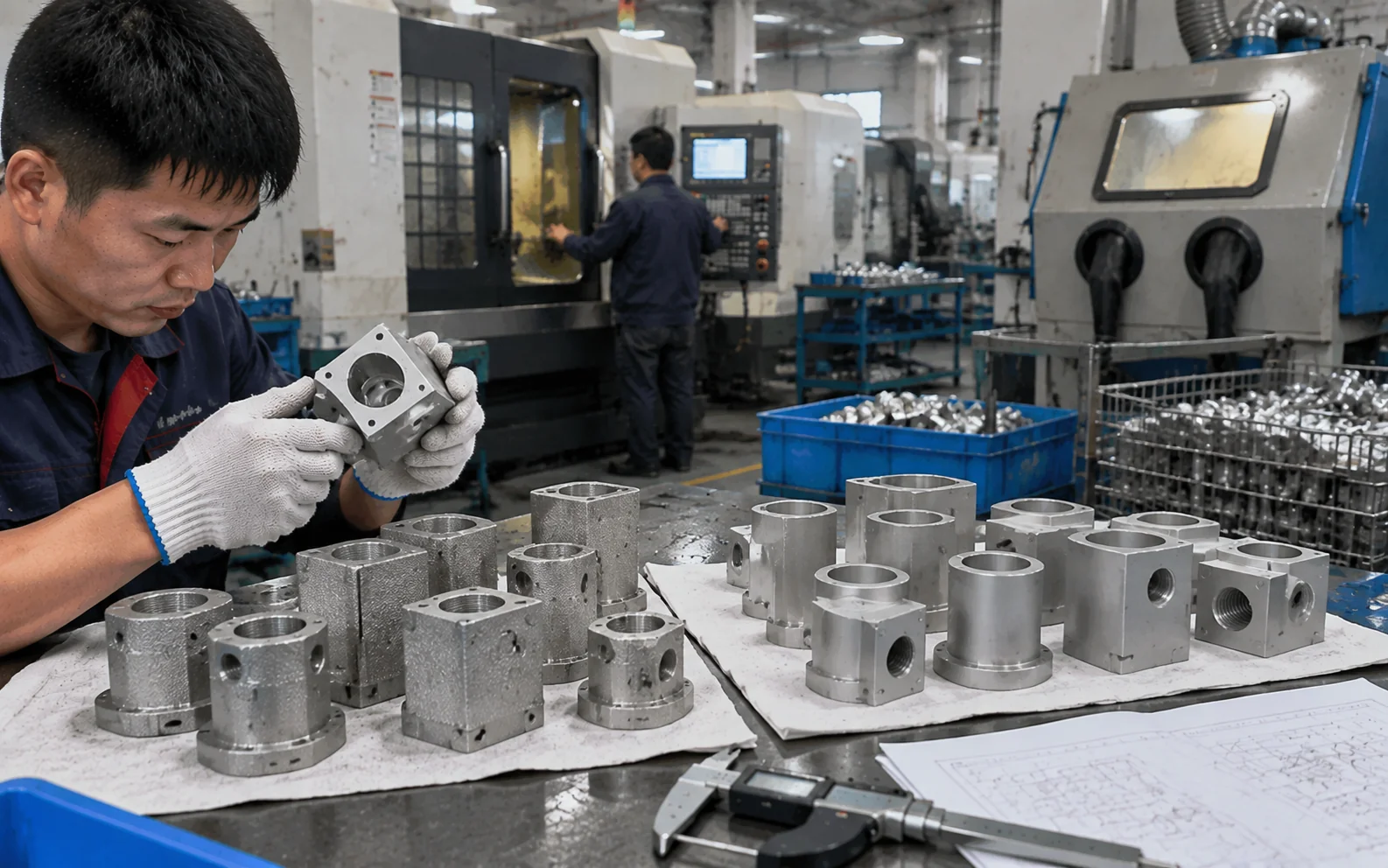
Choosing between sandblasting and bead blasting matters because the finish affects appearance, coating adhesion, corrosion resistance, dimensional consistency, and customer perception of CNC machining parts. For CNC milled aluminum parts, the right process depends on whether you need aggressive surface preparation or a smoother satin cosmetic finish. Luckyhxs helps manufacturers match blasting methods to material, tolerance, function, and production cost.
Video Guide: This overview helps frame the basic difference between sandblasting and bead blasting before comparing them for CNC machined components.
Sandblasting vs Bead Blasting for CNC Parts: Key Differences
Sandblasting and bead blasting are abrasive finishing processes used on CNC parts to clean, texture, deburr, or prepare surfaces. Sandblasting is typically more aggressive, while bead blasting creates a smoother, more uniform matte finish often preferred for sandblasted aluminum CNC parts and bead blasted CNC parts.
Video Guide: This introduction explains the general blasting concepts behind both sandblasting and bead blasting for machined surfaces.
Surface Finishing Purpose for CNC Components
For custom CNC machined parts, blasting is not only cosmetic. It can remove machining marks, break sharp visual edges, improve coating adhesion, reduce glare, and create a consistent texture across milled, turned, or fabricated surfaces.
Sandblasting traditionally uses harder angular media such as aluminum oxide, garnet, or silicon carbide. These particles cut into the surface and produce a rougher profile. Bead blasting uses spherical glass beads, ceramic beads, or similar rounded media that peen the surface more gently, producing a satin or matte appearance.
Based on our internal data and market analysis, here is the breakdown:
| Finish Type | Typical Media Shape | Surface Effect | Common CNC Use |
|---|---|---|---|
| Sandblast finish | Angular | Rougher, sharper texture | Coating prep, oxide removal, heavy cleaning |
| Bead blast finish | Round | Smooth matte/satin texture | Cosmetic aluminum housings, panels, prototypes |
| Fine abrasive blast | Fine angular or round | Controlled texture | Precision custom CNC machined parts |
| Wet blast | Suspended media in liquid | Softer, cleaner surface | Premium aluminum cosmetic finishes |
Luckyhxs Pro Tip: I usually recommend bead blasting for visible aluminum CNC housings and sandblasting only when the part needs stronger adhesion for paint, powder coating, or bonding.
How Sandblasting and Bead Blasting Work on CNC Parts
Both processes propel abrasive media at high speed onto CNC machined surfaces using compressed air or wheel-blast systems. The difference is media behavior: sandblasting cuts and roughens, while bead blasting impacts and smooths. Pressure, nozzle distance, media size, and material hardness determine the final surface texture.
Video Guide: This CNC-focused video is useful for understanding when blasting is appropriate for machined parts and when it may introduce risk.
Process Variables That Control the Finish
Blasting works by transferring kinetic energy from media particles to the part surface. On CNC milled aluminum parts, the process must be controlled carefully because aluminum is relatively soft and can show uneven texture, warping, embedded media, or tolerance changes if the blasting is too aggressive.
A typical workflow includes:
- Part inspection to confirm material, tolerances, visible surfaces, threads, bores, and sealing areas.
- Masking of precision features such as bearing seats, threaded holes, datum faces, O-ring grooves, and optical surfaces.
- Media selection based on desired roughness, coating requirements, and cosmetic standard.
- Pressure setup to balance cutting action, surface uniformity, and dimensional control.
- Blasting pass using consistent nozzle angle, distance, and movement speed.
- Cleaning to remove residual dust, abrasive particles, oils, and static contamination.
- Final inspection for color consistency, roughness, edge condition, and functional dimensions.
Luckyhxs Pro Tip: I always review the drawing before blasting. If the part has tight tolerances, sealing faces, sliding surfaces, or small threaded holes, masking is not optional—it is part of the manufacturing plan.
Is bead blasting better than sandblasting?
Bead blasting is better for cosmetic CNC aluminum parts when you want a soft, even matte finish with less surface damage. Sandblasting is better when you need stronger cleaning, rougher texture, or coating adhesion. The better option depends on function, material, tolerance, and finish expectations.
Video Guide: This video helps explain when bead blasting is useful and when another finishing method may be more suitable.
Choosing by Function, Not by Name
The question of bead blasting vs sandblasting is best answered by looking at the part’s final use. A visible aluminum enclosure, camera mount, robotics bracket, or consumer electronics housing usually benefits from bead blasting. A bracket that will be powder coated, painted, bonded, or repaired may benefit from sandblasting because the rougher surface improves mechanical adhesion.
Based on our internal data and market analysis, here is the breakdown:
| Requirement | Better Choice | Reason |
|---|---|---|
| Premium matte appearance | Bead blasting | Produces smoother, more uniform cosmetic finish |
| Paint or powder coating adhesion | Sandblasting | Creates rougher anchor profile |
| Light deburring | Bead blasting | Less aggressive on edges and surfaces |
| Heavy oxide or scale removal | Sandblasting | More cutting power |
| Tight dimensional control | Bead blasting | Lower risk of excessive material removal |
| Rugged industrial texture | Sandblasting | Stronger surface roughening |
Luckyhxs Pro Tip: I do not treat bead blasting as a universal upgrade. If a customer plans to coat the part, I often choose a controlled sandblast profile instead of a beautiful bead blast that may reduce adhesion.
What is the best blasting media for aluminum?
For aluminum CNC parts, glass bead is often best for a smooth cosmetic matte finish, while aluminum oxide is better for aggressive cleaning or coating preparation. Fine ceramic bead, plastic media, and wet blasting can also work well depending on surface roughness, part geometry, and finish requirements.
Video Guide: This comparison of dry and wet blasting on CNC machined aluminum helps show how media and process style affect the final surface.
Media Selection for Aluminum CNC Parts
Aluminum is softer than stainless steel or titanium, so media choice strongly affects the result. Coarse or overly aggressive abrasives can leave deep texture, darkened surfaces, or inconsistent patterns. For sandblasted aluminum CNC parts, the goal is usually controlled texture—not uncontrolled erosion.
Common media options include:
- Glass bead: Best for satin cosmetic finishes and bead blasted CNC parts.
- Aluminum oxide: Best for stronger cutting, coating preparation, and oxide removal.
- Ceramic bead: Durable option for consistent premium matte finishes.
- Plastic media: Useful for gentler cleaning with lower substrate damage.
- Garnet: Effective for sharper cutting where rougher profiles are acceptable.
- Wet-blast slurry media: Excellent for smoother, cleaner aluminum finishes with reduced dust.
Luckyhxs Pro Tip: For visible CNC milled aluminum parts, I usually start with fine glass bead or ceramic bead and validate with a sample coupon before approving full production.
How expensive is bead blasting?
Bead blasting is usually moderately priced, but cost depends on part size, geometry, masking, batch volume, cosmetic standard, and inspection requirements. Simple small CNC parts may be inexpensive per piece, while complex custom CNC machined parts with threaded holes, sealing surfaces, and strict appearance standards cost more.
Video Guide: This bead blasting process overview helps explain why setup, handling, and consistency influence finishing cost.
Cost Drivers in Bead Blasted CNC Parts
Bead blasting cost is rarely just the blasting time. Most of the cost comes from handling, masking, cleaning, quality control, and repeatability. A simple flat bracket can be blasted quickly, while a complex aluminum housing may require careful masking and multiple controlled passes to avoid uneven shading.
Based on our internal data and market analysis, here is the breakdown:
| Cost Factor | Cost Impact | Why It Matters |
|---|---|---|
| Part size | Medium to high | Larger surfaces require more time and media exposure |
| Geometry complexity | High | Pockets, ribs, and deep cavities are harder to finish evenly |
| Masking requirements | High | Threads, bores, sealing faces, and datums need protection |
| Cosmetic standard | High | Uniform matte appearance requires tighter process control |
| Batch quantity | Medium | Larger batches reduce setup cost per part |
| Post-cleaning | Medium | Residual media must be removed before assembly or coating |
Luckyhxs Pro Tip: I advise customers to specify which surfaces are cosmetic and which are functional. That single clarification can reduce unnecessary masking, shorten lead time, and lower bead blasting cost.
Key Features & Comparison
The main difference between sandblast vs bead blast finish is surface aggressiveness. Sandblasting creates a rougher, higher-friction surface for coating or cleaning, while bead blasting creates a smoother matte finish for appearance. For CNC machining parts, the right choice depends on performance, aesthetics, tolerances, and downstream processing.
Video Guide: This CNC surface finish comparison provides helpful context for choosing blasting alongside other finishing options.
Practical Comparison for CNC Machined Parts
Based on our internal data and market analysis, here is the breakdown:
| Feature | Sandblasting | Bead Blasting |
|---|---|---|
| Surface texture | Rougher, sharper, more abrasive | Smoother, satin, more uniform |
| Common media | Aluminum oxide, garnet, silicon carbide | Glass bead, ceramic bead |
| Best for | Cleaning, paint prep, coating adhesion | Cosmetic aluminum finishes, light deburring |
| Material removal risk | Higher | Lower |
| Appearance | Industrial, textured, less reflective | Matte, premium, consistent |
| Suitability for tight tolerances | Requires more caution | Generally safer with proper control |
| Coating adhesion | Excellent | Moderate unless specified for coating |
| Typical CNC applications | Brackets, fixtures, coated parts | Enclosures, panels, housings, prototypes |
The most important decision is whether the surface must perform mechanically or look cosmetically refined. Sandblasting can produce a stronger mechanical profile but may be too harsh for delicate features. Bead blasting is preferred when the customer wants controlled visual quality without excessive roughness.
Luckyhxs Pro Tip: When we quote custom CNC machined parts, I prefer to define the finish with both method and target appearance—such as “fine glass bead matte finish, visible surfaces only”—instead of simply writing “blast finish.”
Cost & Buying Factors
When buying sandblasted or bead blasted CNC parts, evaluate more than unit price. Consider material, tolerance protection, finish consistency, masking, inspection, packaging, and whether the surface will be anodized, painted, powder coated, or assembled. A lower finishing quote can become costly if rework is required.
Video Guide: This dry blasting demonstration on a CNC machined part shows how different abrasive choices affect surface outcome.
Pricing Guide for Custom CNC Machined Parts
Blasting is often priced as an added finishing operation after machining. The total cost depends on machining complexity and finishing requirements. For sandblasted aluminum CNC parts, buyers should provide drawings, surface callouts, 3D files, photos, or reference samples whenever possible.
Key buying factors include:
- Material grade: 6061 aluminum, 7075 aluminum, stainless steel, brass, titanium, and plastics respond differently.
- Surface requirement: Cosmetic matte, coating prep, anti-glare, deburring, or cleaning all require different controls.
- Protected features: Threads, bores, bearing fits, and sealing faces may need plugs, tape, caps, or custom masks.
- Batch size: Larger production lots usually reduce per-part finishing cost.
- Inspection level: Cosmetic inspection, roughness measurement, and dimensional checks add cost but reduce risk.
- Secondary finishing: Anodizing, passivation, powder coating, painting, or laser marking may change the blasting specification.
- Packaging: Finished matte surfaces can scratch during shipping, so protective packaging matters.
Luckyhxs Pro Tip: I recommend confirming the full process chain before blasting. If the part will be anodized after bead blasting, the blast pattern and cleaning quality must be controlled because anodizing can make surface inconsistencies more visible.
Conclusion
Sandblasting and bead blasting both improve CNC parts, but they solve different problems. Sandblasting is stronger for cleaning and coating preparation, while bead blasting is better for refined matte finishes. For aluminum CNC parts, the best choice depends on appearance, function, tolerances, and downstream finishing.
Video Guide: This short comparison reinforces the practical difference between bead blast and sand blast finishes.
Final Selection Checklist
For most CNC milled aluminum parts, bead blasting is the safer choice when the goal is a premium cosmetic finish. Sandblasting is the better choice when surface roughness, coating adhesion, or heavy cleaning is the priority.
Use this quick decision guide:
- Choose bead blasting for visible housings, panels, brackets, prototypes, and bead blasted CNC parts with a smooth matte finish.
- Choose sandblasting for painted, powder-coated, bonded, or heavily oxidized CNC machining parts.
- Choose fine media and controlled pressure when working with aluminum or tight-tolerance custom CNC machined parts.
- Choose masking and inspection whenever threads, sealing faces, bores, or precision datums are involved.
- Choose Luckyhxs when you need CNC machining and finishing support from prototype through production.
Luckyhxs Pro Tip: If you are unsure which finish to specify, send us the material, drawing, end-use, and a reference photo. We can recommend the most reliable sandblast or bead blast finish before production starts.