

There is no responsible single price for getting a metal part made without first defining the part and the finished deliverable. A quotation may need to cover material, programming, setup, fixtures, machining time, secondary operations, finishing, inspection, documentation, packaging, and shipping. The quantity and design maturity determine how one-time work is distributed across the order.
The phrase “metal part” can also describe very different manufacturing routes. A thin bent cover, a machined bearing housing, a cast body, and a printed prototype should not be priced with the same method. LuckyHXS supplies made-to-drawing and sample-based CNC machined components, so the answers below focus on custom machining while explaining when another process deserves comparison. Buyers can review the broader custom CNC machining service and custom CNC machining parts pages before preparing an RFQ.
The quickest path to a useful estimate is to send controlled files, the exact material and quantity, the features that protect function, the required finish and inspection records, and the delivery destination. A supplier can then price the same finished scope that the buyer actually intends to purchase.
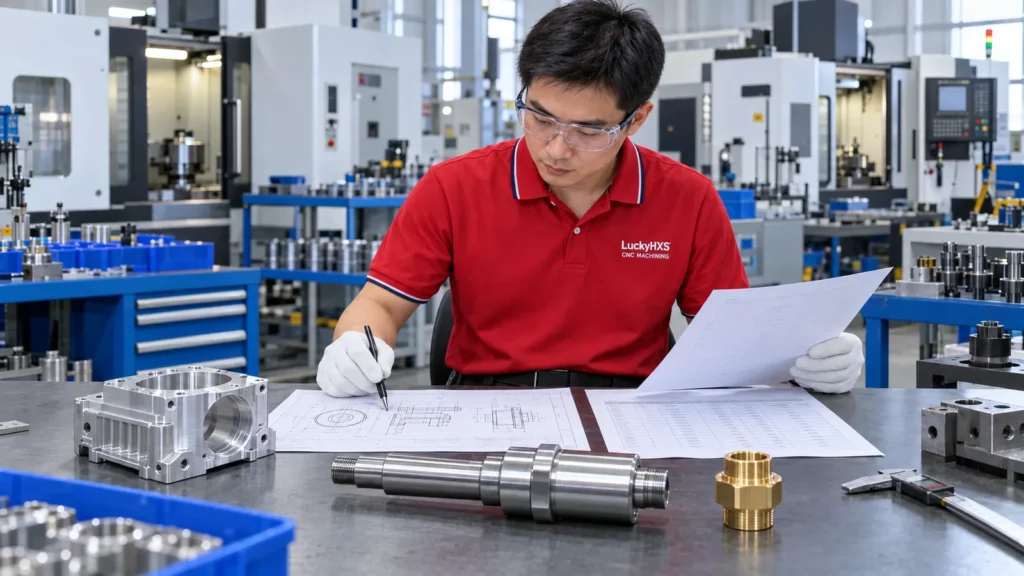
1. How Much Does It Cost to Get a Metal Part Made?
The cost can only be estimated after the part, process, quantity, and acceptance requirements are defined. Two parts with similar outside dimensions may have very different prices if one is a simple turned spacer and the other needs deep pockets, thin walls, intersecting holes, tight related-feature controls, plating, and a dimensional report.
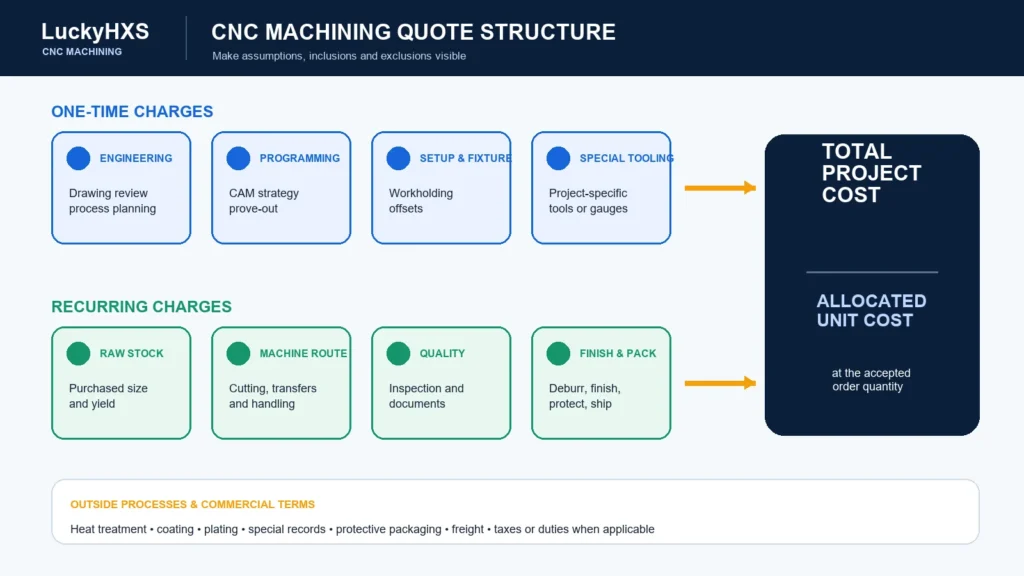
A useful way to understand a quote is:
Project total = one-time charges + recurring manufacturing cost for the accepted quantity + outside processing + required documentation, packaging, and logistics.
One-time charges may include engineering review, programming, fixture design, special tooling, or first-article preparation. Recurring cost may include raw material, machine time, operator attention, tool consumption, deburring, inspection, and normal packaging. Outside processes can include heat treatment, anodizing, plating, passivation, polishing, or other project-approved finishes.
This structure is more useful than an unsupported price-per-piece guess. It also explains why a prototype, a ten-piece order, and a repeat production batch can have different unit economics even when the controlled drawing is unchanged.
2. Why Can’t a Supplier Quote Accurately From a Photo or Rough Description?
A photo can show general shape, but it usually does not define scale, hidden geometry, material grade, tolerance, threads, surface texture, datum relationships, finish, inspection, or acceptable edge condition. Even a physical sample may contain wear, damage, coating buildup, or manufacturing variation that should not be copied.
For an actionable CNC machining quote, send as many of the following as apply:
- A searchable 2D drawing with part number and revision
- A matching STEP or STP solid model
- Exact material grade, standard, condition, and stock preference if controlled
- Prototype quantity, immediate order quantity, and likely repeat quantities
- Critical dimensions, fits, datums, runout, threads, holes, and surface requirements
- Heat treatment, coating, plating, polishing, masking, and color requirements
- Inspection method, sampling rule, report format, and material or process documents
- Burr, cleanliness, marking, packaging, delivery destination, and required receipt date
If only a sample exists, state who may reconstruct the drawing, how the sample will be measured, which wear or damage must not be reproduced, and who will approve the resulting specification. LuckyHXS can review drawing-based or sample-based requests, but the final quotation still needs a controlled acceptance basis.
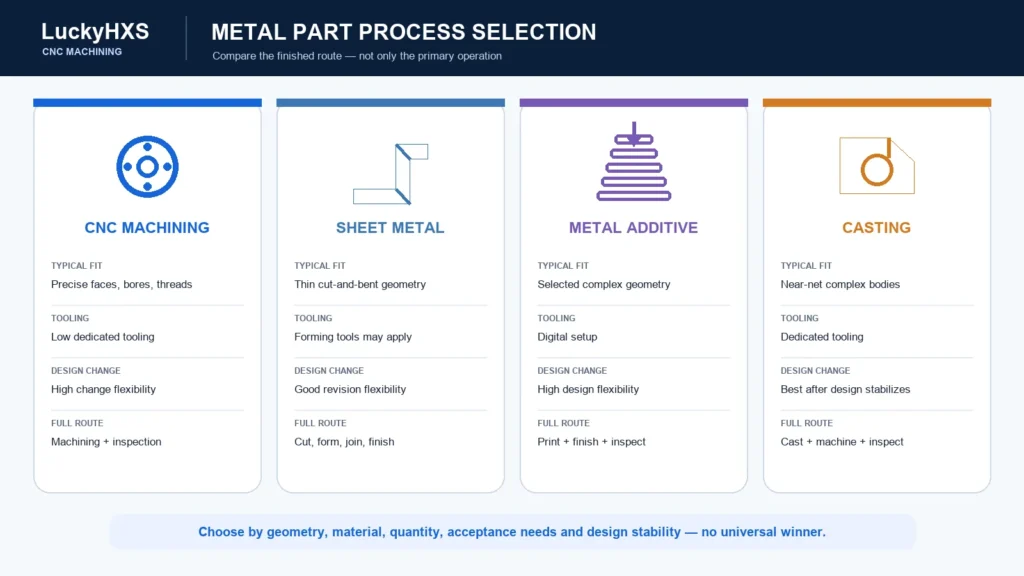
3. Which Manufacturing Process Should Be Used for the Metal Part?
Process choice can change cost more than a small change in machine rate. CNC machining is often appropriate for parts needing accurately related faces, bores, diameters, threads, pockets, or multi-face features in engineering metal. CNC turning suits many rotational parts, while CNC milling suits many prismatic parts. Turn-mill machining can combine rotational and off-axis features when their relationships justify an integrated route.
Other processes may deserve comparison. Sheet-metal fabrication can be economical for thin cut-and-bent enclosures. Additive manufacturing can help with selected complex shapes or early design learning; the guide to CNC machining versus 3D printing explains why material, accuracy, geometry, quantity, and end use matter. Casting or molding may become attractive when the geometry, volume, and design stability justify dedicated tooling.
The comparison must use the finished part, not only the primary shaping operation. Include tooling, machining after casting, deburring, heat treatment, finishing, inspection, expected scrap, packaging, and design-change risk.
4. How Is a CNC Machining Quote Calculated?
A supplier normally builds the quote from a proposed manufacturing route. The route converts the drawing into stock selection, setups, programs, tools, workholding, cutting and handling time, secondary operations, inspection stages, outside processing, and final release requirements.
A practical unit-cost model includes:
- The allocated share of programming, setup, fixtures, and special tooling
- Raw material and the stock that must be purchased, not only the finished-part weight
- Sawing, turning, milling, drilling, boring, reaming, tapping, or grinding time
- Tool consumption and risk from difficult materials or interrupted cuts
- Transfers, refixturing, in-process handling, and secondary machining
- Deburring, cleaning, marking, finishing, and outside-process coordination
- Inspection time, gauges, fixtures, reports, and documentation
- Packaging, freight allocation, and other stated commercial terms
The quote should identify assumptions and exclusions. A low number may omit a finish, special gauge, dimensional report, protective packaging, or a secondary feature that another supplier included. Price comparisons are meaningful only when the deliverable and acceptance basis match.
5. Why Is One Custom Metal Part Often Expensive?
One piece still requires the supplier to review the files, plan the process, source stock, prepare a program, select tools, establish workholding and offsets, prove the setup, machine the part, inspect it, and prepare it for shipment. Many of those activities occur whether the machine produces one part or a larger accepted batch.
The first piece may also carry more uncertainty. The supplier may need extra stock for setup verification, toolpath development, measurement correlation, or rework protection. A novel fixture or special cutter can be necessary even though it will be used for only one delivered part.
For an early prototype, ask the supplier to separate essential functional requirements from features that exist only for appearance or later production. A prototype CNC machining review can identify whether temporary stock, simplified finishing, a different setup, or a staged validation part could answer the engineering question at lower risk. Any change to material, geometry, tolerance, finish, or inspection still requires buyer approval.
6. How Does Quantity Affect the Price Per Part?
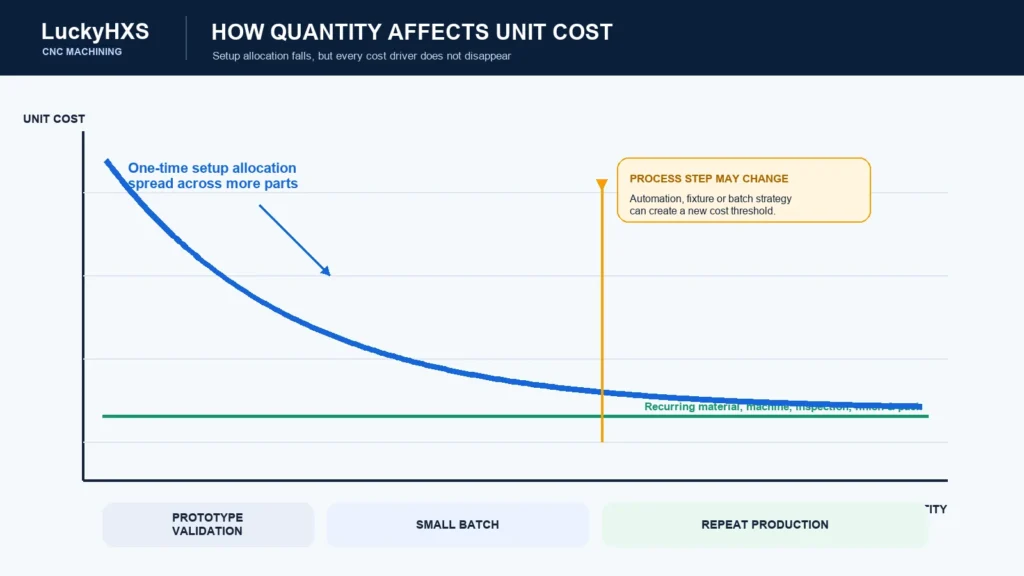
Higher quantity can reduce unit cost because programming, setup, fixtures, special tools, and first-article work are distributed across more accepted parts. Material purchasing, tool use, inspection sampling, packaging, and machine scheduling may also become more efficient at a suitable batch size.
The relationship is not a simple straight line. A larger quantity can require more raw stock, additional tools, longer machine occupancy, more inspection, different packaging, or a more robust fixture. It can also cross a threshold where automation, a bar-fed process, a multi-part fixture, or a different manufacturing route becomes economical.
Buyers should request price breaks for realistic quantities rather than asking for an abstract “best price.” State the prototype quantity, current order quantity, expected annual demand if known, lot-size preference, and design stability. If the design may change after the first build, a smaller validation lot can avoid making a large batch to an obsolete revision.
7. Does Finished-Part Weight Determine Machining Cost?
Finished weight alone is a poor predictor of CNC machining cost. A light part may begin as a much larger plate or bar and require extensive material removal. A heavy but simple spacer may need fewer operations than a small housing with deep cavities, thin walls, tiny holes, and several controlled faces.
The supplier prices the purchased stock form and size, usable yield, preparation, cutting time, chip volume, workholding, tool access, and risk of distortion or scrap. Material that becomes chips still had to be purchased and removed. Oversize stock may be needed for saw allowance, gripping, stress relief, heat treatment, or later finishing.
Weight-based estimating may be useful for an early comparison of simple, similar parts, but it should not replace a drawing-based route. Ask which blank size and stock form the quote assumes and whether the final design can be nested, bar-fed, near-net shaped, or revised to reduce unnecessary removal.
8. How Do Material Grade and Stock Form Affect Cost?
Material affects both purchase cost and the way the part is machined. The exact grade and condition influence availability, standard stock sizes, cutting speed, tool wear, chip control, heat behavior, distortion, attainable surface condition, and compatibility with heat treatment or finishing.
LuckyHXS project reviews may cover aluminum, stainless steel, carbon or free-machining steel, brass, copper, and other requested materials, but the exact grade and availability must be confirmed for the order. Relevant service pages include aluminum CNC machining, stainless steel CNC machining, and brass CNC machining.
Specify grade, governing standard, temper or condition, and required material evidence. Do not assume that two similar alloy names are interchangeable. If substitution is allowed, define which mechanical, corrosion, electrical, thermal, finishing, appearance, and compliance properties must remain equivalent and who has authority to approve the change.
9. Which Design Features Increase Machining Cost?
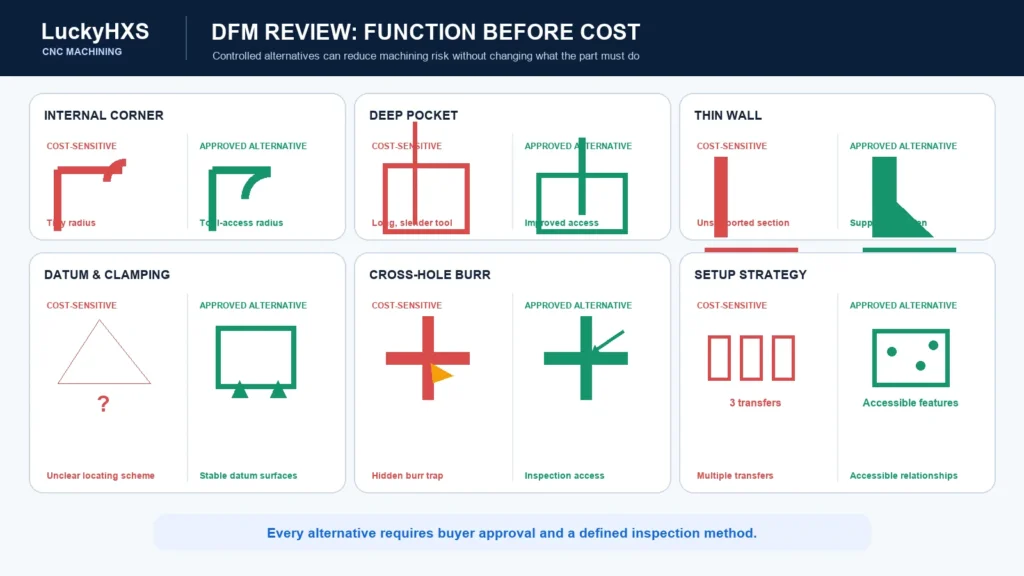
Features become cost-sensitive when they add setups, long-reach tools, special cutters, slow cycles, difficult chip evacuation, fragile workholding, secondary operations, or demanding inspection. Common examples include:
- Deep narrow pockets and small internal corner radii
- Long slender sections, thin walls, broad plates, and asymmetric material removal
- Very small, deep, or intersecting holes
- Deep bores, internal grooves, undercuts, and back-side features
- Many thread sizes, tight thread fits, or limited tool clearance
- Off-axis holes, flats, slots, and radial threads on a turned component
- Several critical faces that must relate across different setups
- Cosmetic surfaces that need protection through multiple operations
- Sharp internal corners that cannot be produced by a round milling cutter
The solution is not automatically to remove every difficult feature. A DFM review should identify function, tool access, datum strategy, workholding, inspection access, and approved alternatives. Larger internal radii, shorter depth, standardized tools, accessible datum surfaces, fewer orientations, or separating cosmetic and functional areas may reduce risk without changing how the part works.
10. How Do Tolerances and Surface Texture Affect Cost?
A tighter tolerance can require a more stable setup, slower finishing cuts, tool compensation, temperature control, additional measurements, special gauges, grinding, or higher scrap protection. Cost depends on the feature, material, size, geometry, datum relationship, process stage, and how the requirement will be verified—not on the number printed after the decimal point alone.
Apply demanding controls only where they protect fit, motion, sealing, alignment, fatigue life, or another defined function. Use the correct drawing language for size, position, profile, flatness, perpendicularity, roundness, or runout rather than relying on vague notes. The guide to how tight tolerances affect CNC machining cost provides more context.
Surface texture should also be assigned by area and function. A bearing seat, sealing face, sliding surface, cosmetic panel, and hidden clearance face may not need the same requirement. State the parameter, limit, direction or lay where relevant, evaluation area, and final condition in which it must be accepted.
11. How Do Heat Treatment and Surface Finishing Change the Quote?
Finishing is part of the manufacturing route, not an isolated color choice. Heat treatment, anodizing, plating, passivation, polishing, blasting, blackening, or coating can add outside-process charges, transportation, scheduling dependencies, masking, handling, dimensional allowance, and final inspection.
The RFQ should define the governing finish specification, color or approved reference where relevant, required thickness or performance, masked areas, cosmetic criteria, and dimensions that apply after processing. Threads, bores, press fits, sealing faces, electrical contacts, and bearing seats may need special planning.
The surface finishing service page can support an initial discussion, but availability and suitability remain project-specific. Ask who controls the outside process, which revision the finisher receives, what evidence is required, and whether the quoted schedule includes the complete finishing and return-inspection cycle.
12. What Inspection and Documentation Can Add Cost?
Inspection cost depends on what must be checked, by which method, at what stage, at what frequency, and in what report format. A simple direct dimension may need only an appropriate hand tool, while a related-feature control, deep bore, profile, or multi-face location may require a dedicated fixture, indicator setup, optical method, bore gauge, thread gauge, or coordinate measurement.
Possible deliverables include first-part results, a first-article report, selected critical-characteristic data, a full dimensional report, material evidence, heat-treatment or coating records, special-process documentation, photographs, and packaging records. These should be requested before quotation so the supplier can plan and price them.
The CNC machining quality inspection page provides a starting framework. The actual plan must follow the controlled drawing, the functional risk, and the order requirement. Requesting “full inspection” without defining characteristics, sampling, method, and records does not establish a comparable scope.
13. Are Programming, Tooling, and Setup Charges Paid Only Once?
Some engineering, programming, fixture, gauge, and special-tool costs may be listed as one-time charges, but their treatment must be stated in the quotation. A charge may apply to the first order, be allocated into unit price, recur after a major revision, or change when the process, machine, material, quantity, or inspection plan changes.
Ask the supplier to identify:
- Which charges are nonrecurring and which are included in unit price
- Whether fixtures, gauges, or special tools are buyer-owned or supplier-owned
- How long project-specific items will be retained and under what conditions
- Who pays for replacement after normal wear, damage, or a design revision
- Whether setup is charged again for repeat orders or small split lots
- What revision or process change triggers reprogramming or revalidation
Do not assume that paying a tooling charge transfers ownership, guarantees indefinite storage, or fixes future pricing. Put ownership, maintenance, retention, reuse, and disposal terms in writing when they matter to the purchasing decision.
14. How Should Buyers Compare Quotes From Different Metal-Part Suppliers?
Compare the complete deliverable line by line. The lowest unit price may be based on a different material condition, blank size, quantity, revision, tolerance interpretation, inspection plan, finish, packaging method, shipping basis, or list of included operations.
Before selecting a quote, confirm:
- Part number, drawing revision, governing 3D model, and approved deviations
- Exact material, condition, stock form, and material evidence
- Quantity, price breaks, one-time charges, and quotation validity
- Proposed process, number of setups, and included secondary operations
- Heat treatment, finish, masking, deburring, cleaning, and marking
- Critical-feature capability and final-condition inspection
- Sampling, report, material, and process-document requirements
- Packaging, destination, freight basis, taxes or duties where applicable
- Schedule start event, dependencies, and required buyer approvals
- Exclusions, unresolved technical questions, and change-control method
Delivery planning should reflect the actual route. The article on CNC machining lead time explains why material, tooling, approval, outside processing, inspection, packaging, and logistics can affect the schedule differently from machine cutting time alone.
15. How Can the Cost of a Custom Metal Part Be Reduced Without Changing Its Function?
Start by defining function clearly. Mark the features that control assembly, motion, sealing, alignment, safety, life, or appearance, then allow the supplier to challenge requirements that do not protect those outcomes. Cost reduction is safest when it is a controlled engineering decision rather than an undocumented shop-floor shortcut.
Possible review points include:
- Use realistic tolerances and surface requirements on noncritical features
- Increase internal radii or improve cutter access where function permits
- Reduce unnecessary pocket depth, stock removal, or unsupported thin sections
- Standardize thread sizes, hole sizes, radii, and commercially available stock
- Provide stable datum and clamping surfaces
- Combine or simplify setups only when feature relationships remain controlled
- Separate prototype validation from cosmetic or full-production finishing
- Select order quantities that balance setup allocation with revision risk
- Confirm whether every requested report, finish, and packaging element is necessary
- Provide accurate forecasts so stock, tooling, and batch strategy can be reviewed
Every proposed change should identify what changes, what remains equivalent, how the finished part will be inspected, and who approves it. A lower-cost part that no longer fits, seals, survives, or satisfies the controlled drawing is not a saving.
Request a Custom Metal Part Cost Review
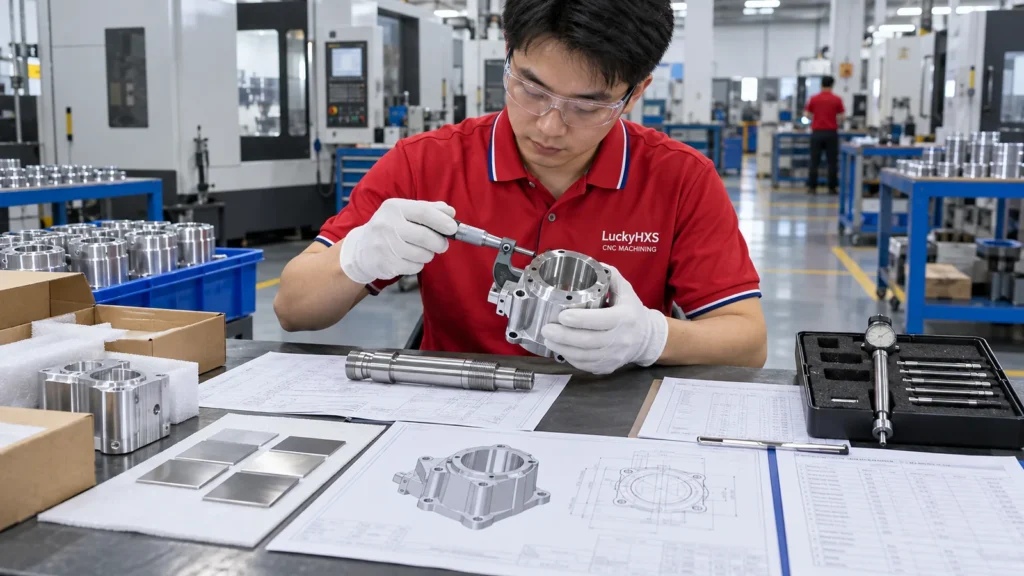
Send LuckyHXS your current 2D drawing and matching 3D model, or an approved sample with written reconstruction requirements. Include the exact material, quantities, critical features, finish, inspection records, packaging, destination, and required timing. LuckyHXS can review the proposed CNC machining route, identify the information that still affects price, and prepare a project-specific quotation based on the finished scope. Contact LuckyHXS to request a cost review for your custom metal part.