

There is no responsible universal price for outsourced CNC machining. The cost depends on the finished part the buyer needs—not simply the outside dimensions, part weight, or time shown on a machine estimate. A useful quotation must account for the controlled drawing and model, material, purchased stock, programming, setups, machining, tooling, secondary operations, inspection, documentation, packaging, quantity, and delivery requirements.
This article addresses the cost of having custom parts manufactured by a CNC machining supplier. It does not cover the purchase price of a CNC machine. LuckyHXS supplies made-to-drawing and sample-based metal and engineering-plastic components through CNC turning, milling, Swiss-type machining, turn-mill machining, and related operations. The exact price, minimum practical order, and schedule must be confirmed from the actual RFQ. Buyers can first review the CNC machining services scope and then use the questions below to prepare comparable quotations.
1. How Much Does CNC Machining Cost?
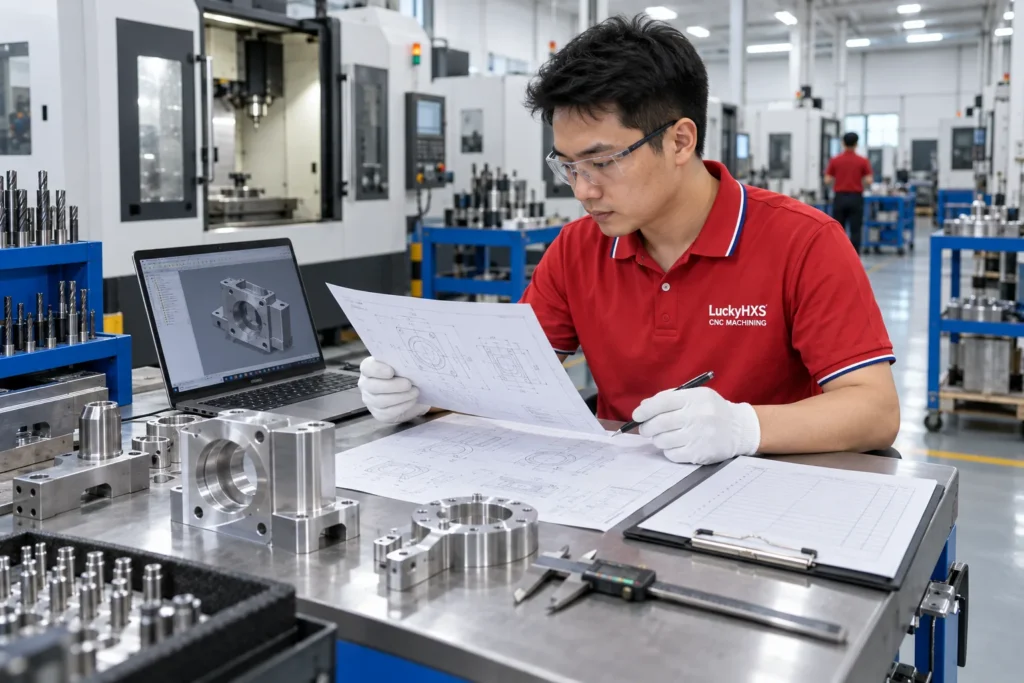
CNC machining cost can only be determined after the finished-part scope is defined. Two parts of similar size can have very different prices when one needs a simple milled profile and the other requires deep pockets, thin walls, several setups, closely related bores, heat treatment, finishing, or a detailed inspection report.
A supplier normally develops the quote from a proposed manufacturing route. That route converts the buyer’s requirements into purchased stock, programming, workholding, tools, machining stages, outside processing, inspection, and final release. A practical cost structure is:
- Raw material and usable stock yield
- Engineering, programming, and setup allocation
- Machine and operator time for each operation
- Standard and special cutting tools, fixtures, or gauges
- Deburring, cleaning, marking, heat treatment, and finishing
- In-process and final inspection, reports, and material or process records
- Packaging, logistics, and other stated commercial requirements
The guide to getting a metal part made compares CNC machining with broader manufacturing choices. For a CNC-specific quote, ask the supplier to state assumptions, exclusions, and the exact deliverable included in the price.
2. Does “CNC Machining Cost” Mean Machine Price or Part Price?
The phrase can refer either to buying a CNC machine or paying a supplier to manufacture parts, but these are different purchasing decisions. Machine ownership involves equipment purchase, installation, tooling, software, operators, maintenance, utilities, floor space, and utilization. An outsourced-part quotation covers the agreed manufacturing and acceptance scope for a particular component or order.
Before comparing search results or supplier proposals, define which question you are asking. This FAQ concerns outsourced custom parts. The relevant inputs are the drawing, 3D model, material, quantity, tolerances, finish, inspection, packaging, and delivery basis—not the list price of a machining center.
This distinction also prevents a misleading comparison between an advertised machine-hour figure and a finished-part price. A part may pass through engineering review, saw cutting, multiple machining setups, deburring, outside finishing, inspection, cleaning, and packaging. Only part of that work occurs while a spindle is cutting.
3. How Is a CNC Machining Quote Calculated?
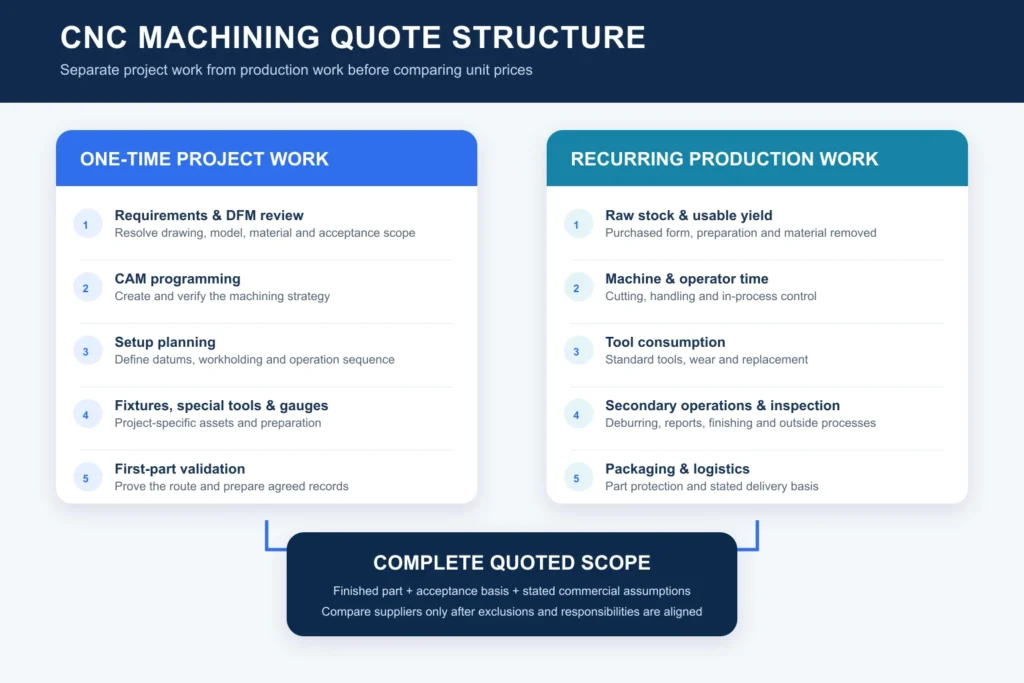
A CNC machining quote is calculated by planning how the complete part will be produced and accepted, then allocating the resulting one-time and recurring costs across the requested quantity. The supplier should review the governing files, identify unclear requirements, choose a manufacturing route, estimate stock and yield, plan setups and tools, and define inspection and outside-process stages.
The estimate commonly contains two groups:
- Order- or project-level work: drawing review, DFM discussion, CAM programming, setup planning, fixtures, special tools, first-part prove-out, and project-specific documentation.
- Part- or batch-level work: raw stock, machine cycle, handling, tool consumption, deburring, finishing, inspection, packaging, and shipment-related requirements.
These groups should not be confused. Dividing a one-time setup across one prototype produces a different unit price from allocating the same setup across an approved batch. Conversely, a larger order can create new costs if it needs additional tooling, material lots, capacity, inspection sampling, or special packaging.
4. Why Is a Machine Hourly Rate Not the Finished-Part Cost?
A machine hourly rate is only one input to a finished-part quotation. It may represent the cost of reserving and operating a particular machine, but it does not automatically include every activity required before, between, and after cutting.
For example, the quoted part may also require:
- Technical review and manufacturing planning
- CAM programming and program verification
- Material purchasing, cutting, and preparation
- Fixture installation, tool setting, offsets, and first-part prove-out
- Transfers between machines or refixturing between operations
- Manual deburring, washing, marking, and part protection
- Heat treatment, coating, plating, polishing, or another outside process
- Dimensional inspection, reports, and document control
- Packaging and freight preparation
Machine rates can also differ because the processes are not equivalent. A suitable three-axis mill, multi-axis machining center, CNC lathe, Swiss-type machine, or turn-mill machine may have different capabilities and operating costs. The lowest stated hourly rate does not necessarily produce the lowest compliant finished-part cost. Compare the complete process and acceptance scope instead.
5. Which CNC Machining Costs Are One-Time, and Which Repeat?
One-time costs are activities or assets created for a particular project or revision, while recurring costs are consumed or repeated as parts are produced. The quotation should identify the distinction because it affects prototypes, repeat orders, and price-break comparisons.
Typical one-time or non-recurring items may include engineering review, CAM programming, fixture design, dedicated soft jaws, special gauges, custom cutters, first-article preparation, and initial process validation. Whether an item is truly one-time depends on tool life, ownership, storage, revision changes, and whether the same production route can be reused.
Recurring costs commonly include stock, machine time, operator handling, standard tool consumption, deburring, cleaning, inspection, finishing, packaging, and shipment preparation. Some costs are mixed. A fixture may be reusable but need maintenance; a program may be reusable but require revision control; a special tool may serve several batches but eventually need replacement.
Ask whether quoted tooling belongs to the buyer or supplier, how long it will be retained, what triggers replacement, and whether a repeat order using the same approved revision avoids part of the original setup work.
6. Why Does a One-Off CNC Prototype Often Cost More Per Part?
A one-off prototype often costs more per part because the engineering, programming, setup, and verification work is allocated to very few pieces. The supplier still has to understand the drawing, select stock, plan workholding, prepare tools, prove the program, produce the first component, inspect it, and resolve any issues—even when only one acceptable part is required.
Prototype cost also depends on what the prototype must prove. A fit-check sample may not need the same cosmetic finish, process records, packaging, or production inspection plan as a fully representative validation part. However, requirements cannot be removed silently. The buyer should state whether the prototype must verify geometry, assembly, load, sealing, wear, material behavior, finishing, or the planned repeat-production route.
The prototype CNC machining services page provides a starting point for defining the validation purpose. If the design may change, a smaller learning batch can reduce the risk of committing material and production capacity to an obsolete revision.
7. How Does Order Quantity Change the CNC Machining Price Per Part?
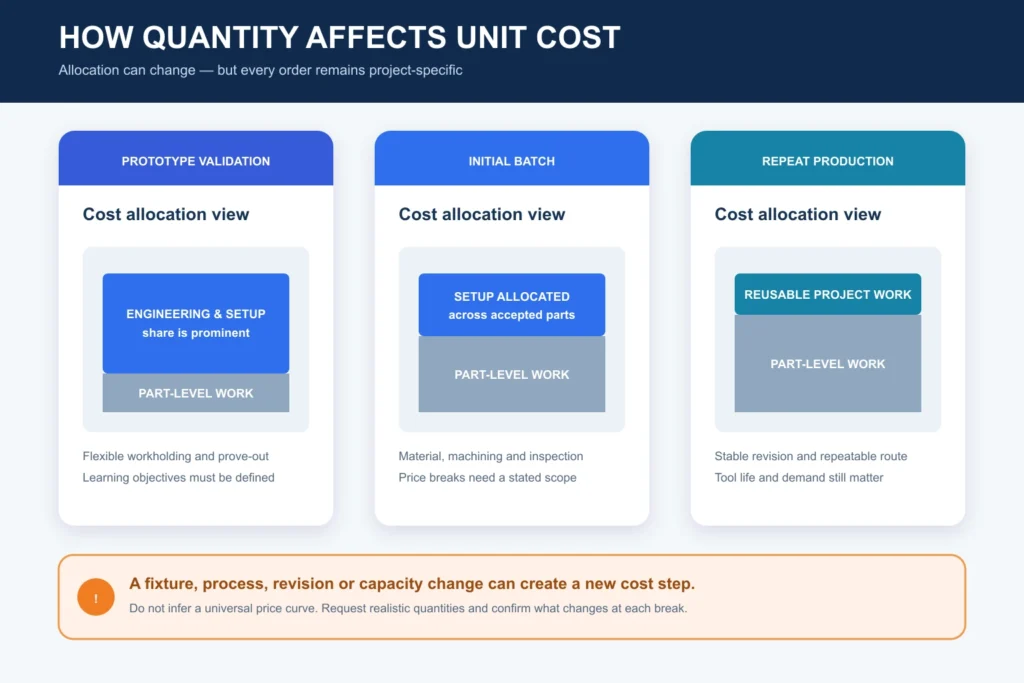
Higher quantity can reduce unit cost when project-level work is distributed across more accepted parts and the supplier can use material, tooling, inspection, and machine capacity more efficiently. The relationship is not a guaranteed straight line, so buyers should request price breaks for realistic order quantities rather than assuming that every volume increase produces the same saving.
Quantity can change the process itself. A prototype may use standard jaws and flexible setups, while a stable repeat order may justify dedicated fixtures, bar feeding, multiple-part workholding, in-process probing, or a different production route. A larger order can also require additional raw-material lots, replacement tools, more inspection, separate releases, or enhanced packaging.
When requesting price breaks, provide the prototype quantity, initial order, expected repeat batch, annual forecast if known, and design maturity. Ask the supplier to identify any quantity threshold where tooling, workholding, inspection sampling, or machine selection changes. This makes the quotation easier to compare and reduces the chance that a price break depends on an unstated process change.
8. How Do Material Grade, Stock Form, and Yield Affect CNC Machining Cost?
Material cost is based on the stock that must be purchased and processed, not only the weight of the finished part. The exact grade, condition, dimensions, availability, minimum purchasable lot, certification requirements, and usable yield can all affect the quotation.
A light finished component may begin as a much larger plate, block, bar, tube, casting, or extrusion. Material removed as chips still had to be purchased, cut, handled, and machined. Parts with large pockets, thick starting stock, awkward orientation, or generous cleanup allowance can therefore have a high material-to-finished-part ratio.
Material also changes machining behavior. Strength, hardness, abrasiveness, thermal response, chip formation, work hardening, stiffness, and sensitivity to clamping can affect tool selection, cutting parameters, cycle time, setup stability, and inspection conditions. Engineering plastics may require attention to moisture, creep, temperature, and stress relief; metals may require condition-specific tools, heat treatment, or finishing.
Send the exact material designation and governing standard where applicable. If substitutions are permitted, define which mechanical, thermal, electrical, corrosion, appearance, compliance, and documentation requirements must remain equivalent and who can approve the change.
9. How Do Part Geometry and Setup Count Affect CNC Machining Cost?
Part geometry affects cost when it creates difficult tool access, additional orientations, long-reach cutting, fragile workholding, slow material removal, special tooling, or demanding inspection. The supplier should evaluate the entire feature set and explain the proposed setup sequence.
Common cost-sensitive conditions include:
- Deep, narrow pockets and small internal corner radii
- Thin walls, long slender sections, and broad flat plates
- Deep bores, internal grooves, undercuts, and back-side features
- Many different hole, thread, radius, or tool sizes
- Intersecting passages that need chip and burr control
- Off-axis flats, slots, cross holes, and radial threads
- Critical relationships that cross several setups
- Cosmetic or sealing surfaces that need protection during handling
Every transfer can add handling, refixturing, datum-restoration, and inspection work. Fewer setups may help, but combining operations is valuable only when it maintains access, stability, quality, and a practical inspection plan. Ask the supplier to show which features are completed in each setup and how functional relationships survive transfers.
10. Do 3-Axis, 5-Axis, Turning, Swiss, and Turn-Mill Machining Cost the Same?
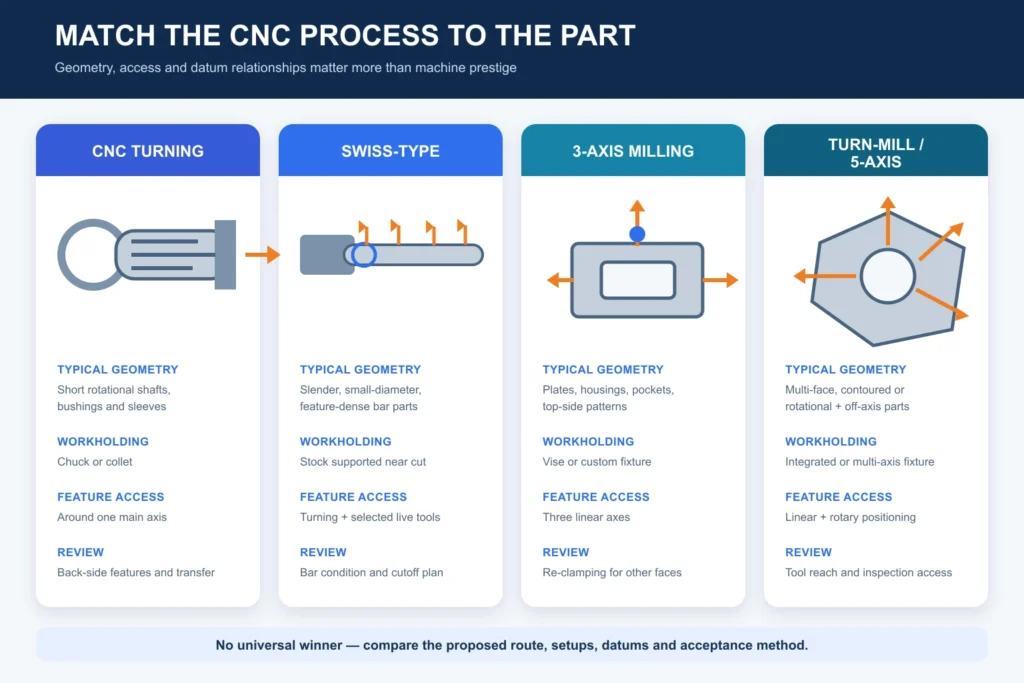
No. These processes use different machine configurations, workholding methods, tooling, programming, and production strategies, so they should not be treated as interchangeable hourly products. The correct route depends on the part’s geometry, size, length-to-diameter ratio, feature access, material, quantity, tolerances, and inspection needs.
CNC milling is often suitable for prismatic parts, plates, housings, pockets, and multi-face geometry. CNC turning is generally suited to rotational parts such as shafts, bushings, sleeves, pins, and fittings. Swiss-type machining may fit selected small-diameter, slender, bar-fed, or feature-dense components. Turn-mill machining can combine rotational and off-axis features when their relationships justify an integrated route.
More axes or a more advanced machine do not automatically make a part cheaper or more accurate. A simple component may be efficient in a stable conventional setup, while a complex part may benefit from fewer transfers on a multi-axis machine. The quote should explain the route, setup count, workholding, datum strategy, included secondary operations, and inspection method.
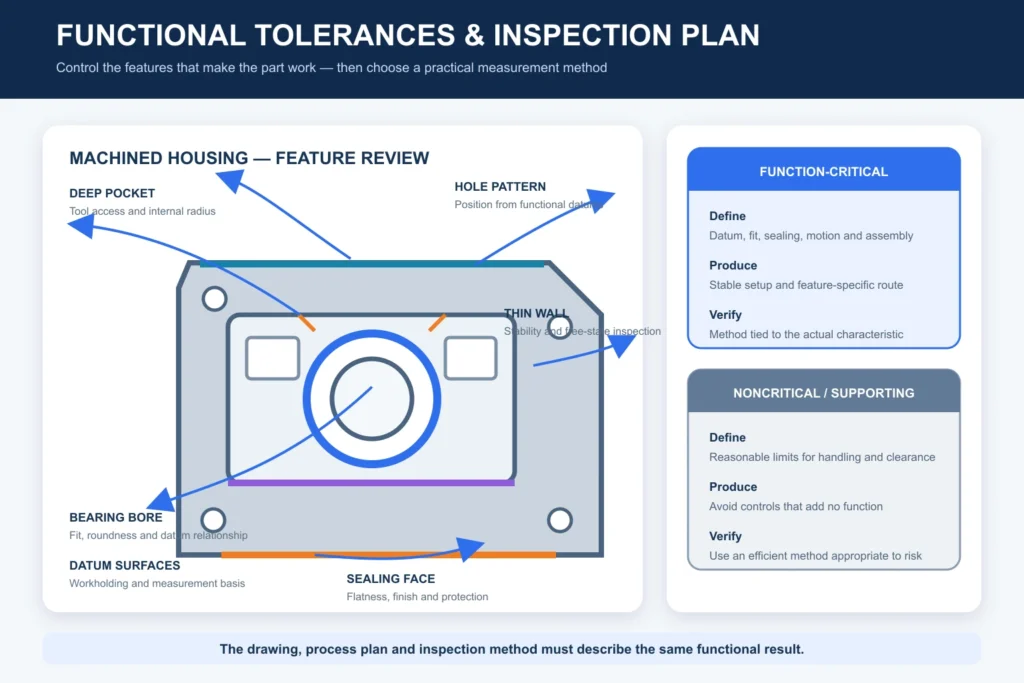
11. How Do Tolerances, GD&T, and Surface Roughness Affect Cost?
Tighter tolerances and more demanding geometric or surface requirements can increase cost when they require a more stable process, slower finishing cuts, temperature control, tool compensation, special workholding, additional measurements, grinding, or a higher scrap-risk allowance. The effect must be evaluated feature by feature; one general tolerance does not describe every part.
Buyers should identify which dimensions and relationships protect function. Critical items may include a bearing diameter, bore fit, sealing face, shoulder location, hole pattern, flatness, parallelism, profile, position, or rotational runout. Nonfunctional dimensions should not receive the same control automatically.
GD&T can reduce ambiguity when the datum structure and controls match assembly function, but conflicting datums, redundant controls, or unclear measurement conditions can increase quotation uncertainty. Surface roughness should also be applied to the relevant faces, not as an unexplained note covering the whole part.
The guide on how tight tolerances affect CNC machining cost explains why tighter is not automatically better. Ask the supplier how each critical requirement will be produced, measured, and maintained across the order.
12. How Do Deburring, Heat Treatment, and Surface Finishing Affect Cost?
Secondary operations affect cost because they add processing, handling, transport, masking, dimensional allowance, inspection, and schedule dependencies beyond the primary machining cycle. They must be included in the released requirements and quotation rather than treated as cosmetic notes added after machining.
Deburring becomes demanding when a part contains cross-hole intersections, internal passages, deep threads, protected sealing edges, or small features that cannot be reached safely by a general edge-break process. Heat treatment can change hardness or geometry and may require machining allowance, stress relief, straightening, or final grinding. Anodizing, plating, coating, blasting, polishing, or passivation can change surface condition and sometimes critical dimensions.
The buyer should define the governing finish specification where applicable, visible surfaces, masking zones, final-condition dimensions, color or texture acceptance basis, and required records. Review the surface finishing service scope during RFQ preparation. If critical burr conditions exist, identify the exact edges and internal intersections on the drawing instead of using only a general “deburr all edges” note.
13. How Much Do Inspection, Reports, and Documentation Add?
Inspection and documentation add project-specific cost because measurement time, gauges, fixtures, sampling, report preparation, traceability, and record control depend on the drawing and purchase requirements. A generic request for “full inspection” does not define what must be checked or how acceptance will be demonstrated.
Depending on the part, the plan may include direct dimensions, bore and thread gauges, indicators, height gauges, optical methods, dedicated fixtures, surface-texture measurement, or coordinate measurement. The supplier also needs to know whether the buyer requires first-part results, a first-article report, selected critical-characteristic data, a full dimensional report, material records, finish or process records, photographs, or special packaging evidence.
The CNC machining quality inspection page offers a framework for discussing feature-based inspection. Before quotation, define the characteristic, production stage, method, frequency, sample size, report format, governing revision, and acceptance rule. Request only the evidence that matches the part’s functional and commercial risk.
14. How Can Buyers Compare CNC Machining Quotes Correctly?
Buyers should compare CNC machining quotes only after confirming that each supplier has priced the same finished deliverable and acceptance basis. A lower number may exclude material documentation, finishing, secondary features, special gauges, dimensional reports, protective packaging, freight, or other work included by another supplier.
Check each proposal for:
- Part number, drawing revision, model, and governing files
- Exact material, condition, stock form, and required evidence
- Quantity, price-break basis, and quotation validity
- Proposed manufacturing route and included setups
- Tooling, fixtures, gauges, ownership, and replacement assumptions
- Included secondary machining, deburring, heat treatment, and finishing
- Critical requirements that remain subject to capability review
- Inspection scope, sampling, reports, and process documents
- Packaging, delivery basis, destination, and schedule start event
- Approved deviations, open technical questions, exclusions, and buyer actions
Normalize these items before comparing unit prices. If the proposals use different processes, ask each supplier to explain how the proposed route meets the same functional and acceptance requirements. Resolve contradictions in writing before releasing a purchase order.
15. What Information Produces the Most Accurate CNC Machining Quote?
The most accurate CNC machining quote comes from a controlled RFQ package that defines the finished component, order demand, operating conditions, and acceptance criteria. The supplier should not have to infer critical requirements from a screenshot, rendering, or incomplete sample.
Send the following where applicable:
- Searchable 2D drawing with part number, units, and revision
- Matching STEP or STP solid model and a rule for model-drawing conflicts
- Exact material grade, condition, stock-form requirement, and substitution rules
- Prototype quantity, initial order, price-break quantities, and forecast if available
- Critical dimensions, datums, fits, threads, surface texture, and edge conditions
- Heat treatment, coating, plating, polishing, masking, and cleaning requirements
- Inspection records, material documents, and process evidence required
- Packaging, part identification, destination, delivery basis, and required receipt date
- Approved sample information and the authority for accepting deviations
Schedule also depends on when approved requirements, material, tooling, samples, and buyer decisions become available. The article on CNC machining lead time explains why the start event and dependencies should be stated rather than replaced by a universal promise.
Request a CNC Machining Cost Review
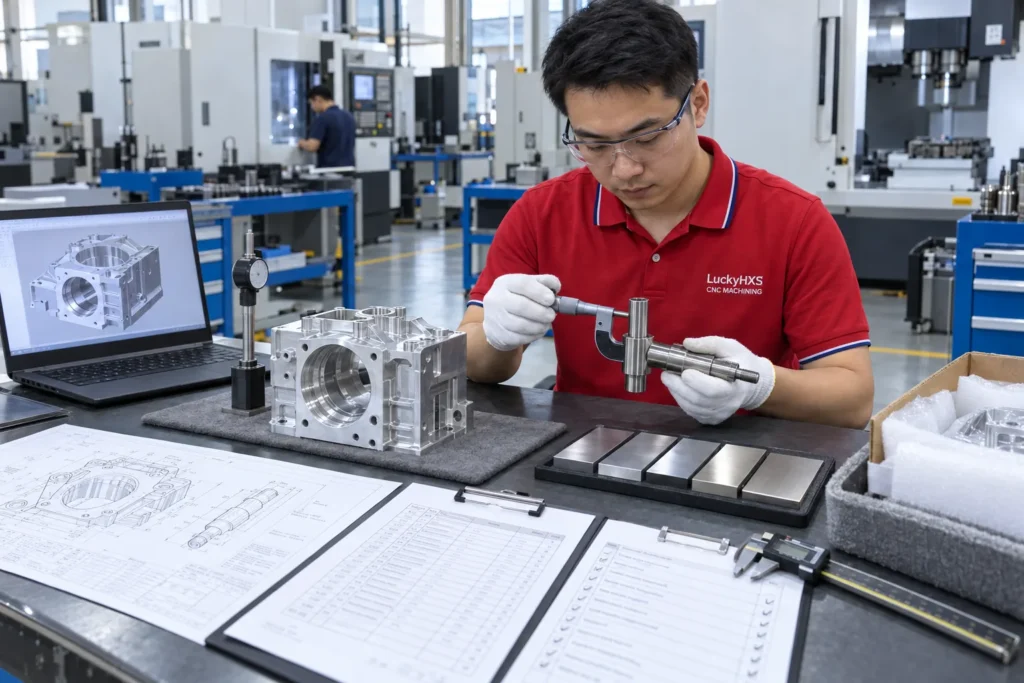
Send LuckyHXS your current 2D drawing and matching 3D model, or an approved sample with clear reconstruction and acceptance instructions. Include the material, quantities, critical features, finish, inspection records, packaging, destination, and required timing. The engineering team can review the scope, identify open questions, and prepare a project-specific quotation based on the complete manufacturing and acceptance route.
Contact LuckyHXS to request a CNC machining cost review.